.png)
How 3D Face Scanning is Reshaping the World
Updated: Aug 27
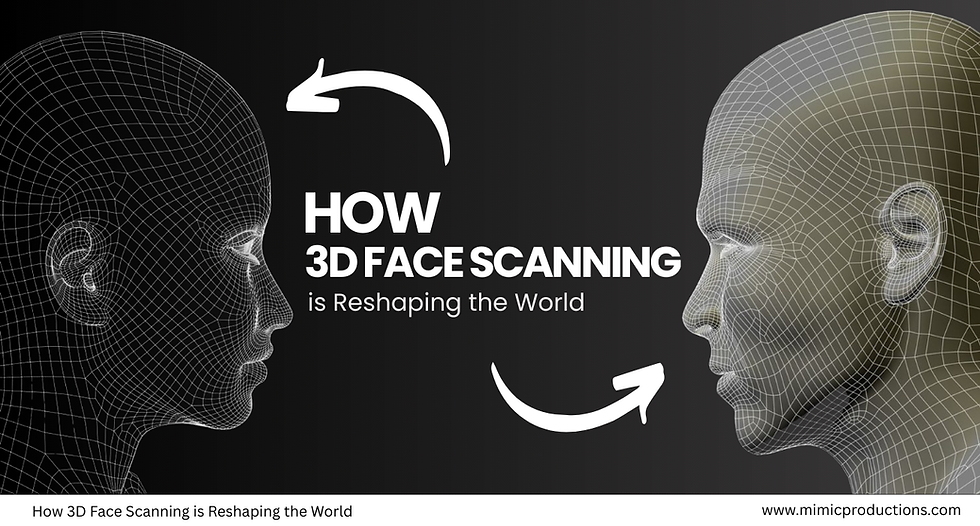
The face has become a dataset.
In clinics, on sets, in game engines and museum labs, 3D face capture is quietly reshaping how we diagnose, design, simulate and perform.
For a studio like Mimic Productions, this is not an abstract shift. High fidelity facial scans sit at the front of the pipeline for digital doubles, AI driven characters, real time experiences and medical visualisation. They anchor everything that follows: topology, facial rigging, performance capture, shading and final rendering.
This guide looks beyond the selfie trend to map where facial scanning is genuinely changing practice: healthcare, dentistry, entertainment, security, heritage, fashion and live experiences. It also looks squarely at the ethical and legal questions that come with turning every face into persistent biometric data.
Throughout, you can assume a production point of view. We treat a scan not as a gimmick, but as the starting point of a serious character or patient workflow.
Table of Contents
From flat portraits to volumetric faces

For decades we relied on two dimensional photography for medical records, casting books and reference on set. It was fast and familiar but fragile. Tiny changes in head angle or lens choice could mislead surgeons, animators and supervisors.
3D facial imaging replaces a single viewpoint with a full surface description of the head. Structured light, laser, photogrammetry or depth cameras project or infer patterns across the skin, then reconstruct a dense point cloud and clean mesh of the face. Recent academic work confirms that modern structured light scanners can reach sub millimetre accuracy for craniofacial measurement, outperforming manual caliper methods for many distances.
For digital human work, this means we can start with an honest representation of bone structure, soft tissue and asymmetry, instead of sculpting likeness by eye alone. For clinicians, it means treatment plans that are driven by geometry, not guesswork.
How face scanning actually works

Different systems vary in detail, but the capture flow is similar.
The face is lit or observed with a known pattern, from several viewpoints.
Cameras record RGB colour and depth information across a fraction of a second for desktop units, or several seconds for handheld and mobile setups.
Software aligns multiple frames, removes noise, fills gaps and produces a watertight mesh of the head.
High resolution textures are baked to the surface.
In advanced pipelines, the mesh is wrapped onto a clean, production ready topology and linked to a facial rig.
Research in dentistry and orthodontics shows that newer smartphone depth cameras and structured infrared light can generate face scans that are surprisingly close to dedicated reference systems, especially for soft tissue assessment and documentation. That is pushing volumetric capture out of the lab and into everyday clinics.
At Mimic, we still separate exploratory scans from hero scans. Quick smartphone captures are useful for previs, layout or rehearsal, but final digital doubles demand controlled light stages, neutral lenses and calibrated head rigs. The scan is treated as principal photography, not a convenience.
Hardware landscape for facial capture

There is no single correct device. Each class of scanner has a niche.
Desktop unitsThese are fixed multi camera systems that capture the whole face in a fraction of a second. They deliver very stable geometry and consistent lighting, making them ideal for clinics and for photoreal asset creation. They align naturally with services like 3D body scanning, where full body capture and facial capture run in the same controlled environment.
Handheld scannersPortable structured light units let operators orbit around the subject. They are flexible and a better fit for on set work or tight locations, but they depend heavily on operator skill. Studies in dental markets note the trade off between mobility and increased risk of motion artefacts or drift during longer passes.
Smartphone based captureModern smartphones and tablets now ship with depth sensors and LiDAR in the front camera stack. Technical evaluations show that these devices, paired with specialised apps, can reach clinically acceptable accuracy for orthodontic documentation, with shorter scanning times and lower cost than traditional camera systems.
The production reality is simple. High end scanners are still the tool of choice for hero assets and critical surgeries, while mobile capture expands the situations where a scan is even possible.
From face scan to digital human

In a digital human pipeline, a face scan is only the beginning. A typical Mimic style process looks like this.
Capture: High resolution facial scan with neutral and expression poses, captured under calibrated light.
Retopology and sculpting: The scan is wrapped to a clean, animation friendly mesh. Sculptors refine anatomy while respecting the underlying data. This aligns closely with our work on photo realistic 3D character models, where likeness is non negotiable.
Facial rig and deformation system: Technical artists build a rig that supports FACS based expression sets, speech and subtle micro expression. Assets can share a core facial rig family so that future scans slot into an existing performance system. This dovetails with dedicated body and facial rigging services.
Performance capture: Facial motion capture or markerless tracking drives the rig with real performances.
Shading and rendering: Skin, eyes and hair are shaded for either offline rendering or real time engines, with physically based maps derived from scan textures.
Once a face lives inside a robust rig, the same likeness can appear in film visual effects, game engines, interactive XR installations and conversational systems powered by AI avatars.
Comparison table
Below is a practical comparison of common approaches to capturing the human face today.
Face capture method | Data produced | Typical use cases | Strengths | Limitations |
Two dimensional photography | Flat image with no depth | Basic documentation, casting, before or after records | Fast, cheap, universal | Sensitive to angle and lighting, difficult to measure, poor for simulation |
Dedicated 3D face scanner | Full surface mesh and textures | Surgery planning, digital doubles, dental workflows, high end research | High accuracy, repeatable, strong for measurement and rigging | Higher cost, fixed locations, training required |
Smartphone depth camera with scanning app | Medium resolution mesh with RGB textures | Orthodontic records, quick digital dentistry, consumer experiences | Low entry cost, accessible, integrates with existing devices | Lower resolution, reliant on user skill, less control over optics |
The right choice depends on whether you need an impression of a face, or a production grade representation that can withstand inspection from surgeons, audiences and supervisors.
Applications

Healthcare and surgical planning
Facial scanning is quietly becoming a core tool in surgery, orthodontics and prosthetics. Clinical papers describe its use as a foundation for virtual patients, combining the face mesh with intraoral scans and CBCT data to align bone, teeth and soft tissue in a single digital record.
Key domains include
Maxillofacial surgery where surgeons simulate osteotomies on a 3D skull and evaluate how soft tissue will respond.
Orthodontics, where facial models plus digital dental impressions allow clinicians to plan tooth movement in relation to the entire face instead of the dental arch alone.
Custom prosthetics for trauma or congenital conditions, using mirrored anatomy and volumetric prints to restore both function and appearance.
This blends naturally with Mimic level medical visualisation, where the same precision meshes can appear in patient education, device marketing and simulation for medical partners.
Digital dentistry and smile design
Dental teams increasingly treat the face as the primary frame for any restoration. 3D face capture paired with intraoral scanning lets them design veneers, full arch rehabilitation or implant restorations that respect lip dynamics, smile line, and facial symmetry.
Studies highlight benefits for chair time and fit, but practitioners also report a softer benefit: patients understand their treatment. They can see proposed outcomes mapped back onto their own digital twin rather than a generic model.
Entertainment, games and virtual production
The entertainment industry adopted facial scanning early, first for static likeness, then for fully animated digital doubles. Specialist vendors already use scan stages to create cyber scans with pore level detail for film, game cinematics and advertising.
Practical uses today
Creating hero doubles of lead actors for complex action beats or impossible camera moves.
Building face libraries of extras for crowd simulation and background casting.
Driving real time digital humans on LED stages, where face rigs respond immediately to performance capture inside engines.
In this context, services like 3D animation and VFX are no longer separate from scanning. They are downstream expressions of the same core dataset.
Security and biometric access
Face recognition now governs phone unlock, border crossings, office entry and even payment flows in some regions. 3D scanning improves robustness by capturing depth and contour, reducing vulnerability to simple spoofing and improving match rates under varied lighting.
However, as legal and industry analyses keep stressing, the same systems raise serious privacy questions when deployed for mass surveillance or consumer tracking without clear consent, transparency or recourse. We return to this under Challenges.
Cultural heritage and museums
Heritage teams use 3D scanning to preserve fragile sculptures, sarcophagi, masks and entire archaeological sites. These digital surrogates support research, restoration and public engagement.
Face specific projects include
Reconstructing historical figures from skeletal remains.
Documenting erosion and damage over time on carved heads or reliefs.
Creating interactive exhibits where visitors can rotate and examine artefacts in detail or see reconstructions projected onto skeletal data.
Fashion, beauty and retail
Retailers are experimenting with face based fitting experiences for eyewear, cosmetics and headgear. By calibrating a virtual try on around a real 3D face, they can approximate fit and appearance far better than earlier flat image filters.
Some of these flows will ultimately link to full body capture, digital fashion and virtual influencers, where faces become a bridge between a shopper’s identity and a persistent digital persona. Here, realistic facial assets tie directly into offerings like digital fashion and live virtual talent for brands.
Industrial design and ergonomics
Product teams use facial scans to design respirators, headsets, helmets and other head mounted devices. Precise anthropometric data drives comfort, safety and long term wearability. Industry groups already share anonymised scan libraries to ensure that new hardware serves a wide range of head shapes, not just an average mannequin.
Benefits

Geometric truth instead of approximation
3D face capture measures what is actually there. For surgeons and orthodontists this means better prediction, fewer surprises and reduced need for corrective procedures. For digital human teams it means a stronger base for likeness, aging, deformation and shading.
Shared digital patient or performer
Once a face exists as a clean mesh, it can serve many roles. The same asset can sit inside a surgical planning suite, a dental design tool, a simulation environment and a real time engine. Workflows that once lived in separate silos can finally converge around a single digital person.
Stronger communication
Volume carries narrative. Patients, actors, directors and executives understand a 3D representation of a face much faster than a list of measurements or a flat render. Being able to orbit around a proposed result makes it easier to align expectations, secure approvals and avoid conflict later.
Efficiency across the pipeline
For Mimic level productions, a good scan saves weeks. It shortens sculpting, rigging and look development, reduces iteration during lighting and makes it easier to reuse characters across projects. In clinics, studies report shorter chair time and more predictable lab work once face scans enter the digital dentistry workflow.
Foundation for real time experiences
Real time characters in XR, games and conversational interfaces need efficient yet believable faces. Starting from accurate capture enables rigs and shaders that can be simplified for performance without drifting away from the original person. This is where scanning links directly to realtime integration and AI native experiences.
Bias and misidentification
Large scale facial recognition systems have a documented history of misidentifying people from under represented groups at higher rates. That risk can be reduced, but never fully removed, by using richer 3D data and better training sets.
For entertainment and design work, the more subtle risk is aesthetic bias. If scan libraries over index on certain faces, teams may unconsciously lock into narrow norms of beauty, age or anatomy. A diverse capture library is a technical and cultural requirement.
Cost, training and workflow integration
High quality scanners, controlled lighting and experienced operators still carry a cost. For many clinics and smaller productions, smartphone based systems are attractive precisely because they promise low cost and short learning curves. Yet research reminds us that mobile workflows require careful validation and protocol if they are to replace traditional methods.
The lesson is familiar from motion capture and virtual production. Hardware is only half the problem. Real value arrives when scanning is fully integrated into scheduling, budgeting, asset management and delivery. That is where specialist partners and end to end 3D character services matter.
Deepfakes and misuse
As 3D facial assets become easier to capture and drive, the line between authorised digital doubles and malicious impersonation can blur. Robust contractual protection, watermarked pipelines and clear visual language around synthetic content are all part of responsible deployment.
Future Outlook

Three trends are likely to shape the next decade of facial capture.
Clinical grade scans from everyday devices: Research already shows that carefully designed mobile apps and depth cameras can approach the accuracy of more expensive systems for certain dental and orthodontic tasks. We can expect more device makers to expose depth data in controlled ways, and more regulators to define what is acceptable for diagnosis.
Embodied AI characters that remember your face: As conversational agents gain bodies and spatial presence, high fidelity facial models will become the default interface. The same mesh that was once created for a film can, with consent, become the face of a persistent AI representative, or live in mixed reality installations alongside real performers. This is already visible in projects that blend digital doubles, holographic displays and performance capture stages.
Stronger regulation for biometric data: Governments are beginning to respond to public concern by introducing specific rules around facial recognition, consent and data retention. Recent examples range from privacy guidance to direct limits on compelled use of face based identification in public spaces. Actors across healthcare, retail and entertainment will have to treat facial data with the same seriousness as financial records.
For a studio working at the intersection of scanning, performance capture and AI, this future is less about novelty and more about discipline. The winners will be the teams that can move effortlessly between clinical precision, cinematic storytelling and ethical custodianship of biometric data.
FAQs
What is 3D face scanning in simple terms?
It is the process of capturing the exact shape and colour of a person’s head with cameras and depth sensors, then rebuilding it as a detailed digital model that can be measured, animated or used for visualisation.
How is this different from traditional photography
Photography freezes a view of the face from a single angle. 3D capture records the entire surface, which means you can view it from any direction, extract measurements and simulate changes over time. It is the difference between a portrait and a digital sculpture.
Where does Mimic style face capture sit in a full character workflow?
In a typical Mimic pipeline, a facial scan comes immediately after casting and look design, and before rigging and performance capture. The scan informs topology, shading and deformation, then feeds into real time or offline rendering depending on the project.
Is mobile face scanning good enough for production work?
For hero characters and demanding visual effects, dedicated scanners in controlled conditions still deliver the best results. Mobile solutions are valuable for rehearsal, previs, background characters and some clinical records, but they usually require additional clean up before entering a film grade asset pipeline.
How should studios and clinics think about consent?
Best practice is to treat every scan as sensitive biometric data. That means clear written consent, transparent explanation of how the data will be used, strict access controls, explicit retention periods and an easy way for subjects to revoke permission in the future.
Conclusion
3D face capture has matured from a novelty into shared infrastructure for medicine, entertainment, heritage and retail. It allows surgeons to plan transformative procedures with confidence, dental teams to design truly individual smiles, museums to resurrect lost faces, and studios to create digital humans that feel grounded in reality rather than fantasy.
The technology is powerful precisely because it collapses distance between the physical and digital person. That power demands care. At Mimic, we treat each scan as both creative raw material and a representation of someone’s identity that deserves respect. When precision, storytelling and ethics move together, 3D face scanning stops being a gadget and becomes a craft.
For inquiries, please contact: Press Department, Mimic Productions info@mimicproductions.com


Comments