.png)
Full Body 3D Scanning for Fashion & Virtual Try On
Updated: Aug 31

What changes when fashion stops guessing the body and starts working from a precise digital replica?
That question sits at the center of modern apparel technology. As fit returns continue to erode margins and customers expect more confidence before checkout, brands are looking beyond flat size charts and generic avatars. Full body capture offers a more reliable foundation. Instead of approximating shape from a few measurements, it records body volume, posture, proportion, and surface detail in a form that can move through digital design, garment simulation, retail visualization, and virtual commerce workflows.
This is why 3d body scanning fashion is gaining real traction across luxury, sportswear, made to measure, digital apparel, and virtual try on platforms. It gives brands a cleaner starting point for fit analysis, a more believable digital body for online presentation, and a stronger bridge between physical product development and real time customer experience.
For studios and fashion technology teams, the value is not in the scan alone. It is in the pipeline that follows. A scan becomes useful when it is cleaned, retopologized, rigged where needed, paired with accurate garment assets, and deployed into a system that supports realistic drape, responsive sizing logic, and visual consistency across devices. That production reality is where the conversation becomes serious.
Table of Contents
What Full Body 3D Scanning Means in Fashion

In fashion, full body scanning is the process of capturing a person’s physical form as structured three dimensional data. Depending on the setup, that data may include geometry, body measurements, surface texture, silhouette, and posture information. The result can serve several purposes. It can become a fit reference, a base mesh for digital styling, a body double for simulation, or a customer specific asset for personalized retail experiences.
The rise of 3d body scanning fashion reflects a wider shift in apparel production. Brands no longer treat digital bodies as rough placeholders. They increasingly need technically credible human models that can support pattern development, digital sampling, ecommerce visualization, and immersive customer journeys. That is especially true when products are sold through virtual fitting rooms, digital showrooms, or avatar based experiences.
A scan also becomes more valuable when connected to adjacent production disciplines. A fashion brand exploring body accurate visualization may need support from a dedicated 3D body scanning pipeline, but the workflow often extends into garment creation, asset optimization, and deployment environments that demand more than raw capture alone.
Why Virtual Try On Needs Better Body Data

Many virtual try on experiences still fail for a simple reason. They place garments on generic bodies and expect customers to trust the result.
A believable fitting experience depends on more than chest, waist, and hip values. It requires a representation of body depth, shoulder angle, stance, torso length, limb proportion, and how fabric responds to those variables. When that underlying body model is wrong, everything downstream begins to drift. Sleeves appear too clean. Waist tension looks artificial. Hem placement feels inconsistent. The customer senses the inaccuracy even when they cannot name it.
This is where 3d body scanning fashion offers practical value. It improves the body input that drives the visualization. A stronger body model allows simulation teams to produce more convincing garment behavior, especially when paired with detailed apparel assets built for digital fashion workflows. In high fidelity retail environments, that difference is not cosmetic. It affects trust, conversion, and return likelihood.
For premium brands, better body data also supports a broader creative ambition. The same scan can inform ecommerce fitting, virtual showrooms, campaign imagery, and avatar based retail experiences. Instead of rebuilding the body for every channel, teams can work from one controlled digital source.
How the Scanning Pipeline Works
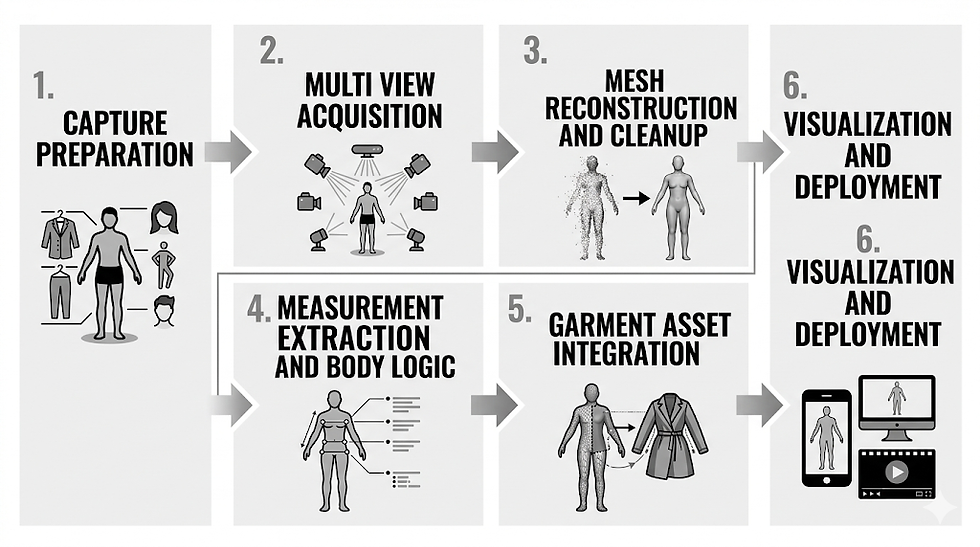
A fashion ready body capture pipeline is never just a person stepping into a scanner. The useful output comes from the decisions made before and after capture.
1. Capture Preparation
The subject is prepared for acquisition with wardrobe, pose, and hair considerations in mind. For fashion use cases, this stage matters because loose clothing, occlusion, and reflective materials can distort geometry. If the goal is garment fit or body accurate simulation, the capture conditions must be controlled carefully.
2. Multi View Acquisition
The body is recorded using an array of cameras, structured light systems, depth sensors, or photogrammetric setups. The choice depends on the required fidelity, throughput, and commercial use case. A retail scale fitting system may prioritize speed and standardization. A studio pipeline for campaign grade assets may prioritize dense geometry and texture detail.
3. Mesh Reconstruction and Cleanup
Raw capture data is reconstructed into a body mesh. This stage usually reveals the gap between acquisition and production readiness. Holes, noise, asymmetry, and surface artifacts must be corrected. Topology may need to be rebuilt for simulation, animation, or efficient rendering.
4. Measurement Extraction and Body Logic
For fashion applications, geometry alone is not enough. Teams often derive structured body measurements, landmark points, and categorical fit data from the scan. This is what allows the body to feed size recommendation systems, grading studies, or made to measure workflows.
5. Garment Asset Integration
Once the digital body is stable, apparel assets are fitted to it. Depending on the target platform, this may involve cloth simulation, shrink wrapped previews, size set comparisons, or retargeted dressing systems. The quality of the garment asset is as important as the quality of the body.
6. Visualization and Deployment
The final body may be deployed in ecommerce, game engine environments, immersive retail, or customer facing applications. At this stage, optimization becomes critical. A scan intended for a cinematic render is built differently from a body intended for real time retail delivery. When photoreal presentation matters, teams often combine scan derived anatomy with refined character work such as photo realistic 3D character models to preserve both credibility and performance.
This end to end view is why 3d body scanning fashion should be treated as a pipeline decision, not a device purchase.
Full Body Scanning Compared with Traditional Sizing Methods
Method | What it captures | Strengths | Limitations | Best use case |
Manual measurements | Selected circumferences and lengths | Low cost, widely understood | Misses posture, volume, and body shape nuance | Basic tailoring and standard size selection |
Size chart matching | General body range assumptions | Simple for mass retail | Weak fit confidence, limited personalization | Conventional ecommerce |
Photo based estimation | Approximate silhouette and proportions | Accessible through consumer devices | Accuracy can drift from lens distortion, pose, and lighting | Lightweight consumer tools |
Full body 3D scanning | Body shape, depth, surface geometry, posture, and measurements | Strong for virtual try on, fit studies, and digital twin creation | Needs cleanup, asset processing, and deployment strategy | Premium retail, digital fashion, custom fit, immersive commerce |
The comparison is straightforward. Traditional methods reduce the body to a few numbers. Scanning preserves the body as a volumetric form. That distinction becomes decisive once brands move into virtual fitting, personalized retail, or body based product development.
Applications Across Fashion and Retail

Virtual Try On for Ecommerce
The most visible use case is customer facing try on. Here, body accurate digital humans can display size dependent garment behavior more convincingly than template avatars. This is one of the clearest commercial expressions of 3d body scanning fashion, especially for categories where fit drives purchase hesitation.
Made to Measure and Premium Tailoring
Tailored garments benefit from a richer understanding of body shape than standard measurements alone can provide. A scan can support more consistent pattern adjustment, especially when asymmetry, posture, or specific silhouette preferences matter.
Digital Twins for Fashion Campaigns
A scanned body can become the basis for a digital twin used in look development, concept testing, and virtual presentation. This is particularly useful when a brand wants continuity between physical talent, avatar based storytelling, and commerce assets. The broader strategic case is already visible in fashion’s move toward digital replicas and identity driven experiences, as explored in digital twins in the fashion industry.
Product Development and Fit Research
Design teams can compare garments across body types without producing as many physical samples. In practice, that can support earlier design validation, more informed grading decisions, and tighter communication between design, technical development, and visualization teams.
Real Time Retail and Immersive Commerce
As fashion experiences move into interactive showrooms and live retail interfaces, scan derived bodies need to perform well in responsive environments. That requires engine ready assets, optimized materials, and stable deployment workflows. For that stage, fashion teams often rely on real time integration to move from static body assets to interactive systems.
Benefits for Brands, Designers, and Customers

Better Fit Confidence
The most immediate benefit is a stronger relationship between what the customer sees and what the garment is likely to do on their body. Better visualization does not eliminate returns on its own, but it creates a more credible decision environment.
More Efficient Sampling Workflows
When teams can test garments digitally on body accurate forms, they reduce some of the guesswork that usually appears early in development. That can help streamline internal review cycles, especially across geographically distributed teams.
Stronger Personalization
Personalization becomes more meaningful when it is tied to actual body structure rather than style quizzes alone. This matters for tailored clothing, athletic wear, shapewear, adaptive apparel, and premium fashion services.
Asset Reuse Across Channels
A robust scan can support more than fitting. It can feed retail visualization, digital showrooms, social content, virtual influencers, and immersive brand environments. That makes 3d body scanning fashion strategically useful beyond a single tool or campaign.
Higher Quality Digital Humans
Body capture becomes even more powerful when combined with strong downstream character development. If the final use case extends into branded avatars, virtual retail staff, or stylized fashion presentations, teams may connect body data to broader 3D character services rather than treating the scan as a terminal asset.
Future Outlook

Fashion is moving toward a more persistent digital representation of both garments and people. In that environment, the body is not just a customer input. It becomes a structured data object that can travel across design, retail, and experience layers.
The next phase will likely be defined by four converging shifts.
Better consumer capture pipelines that reduce friction while improving anatomical reliability
Stronger cloth simulation informed by body specific tension, volume, and pose
Wider use of avatar based commerce where scanned identity and branded expression meet
Greater demand for ethical handling of biometric data, consent, storage, and digital likeness rights
As these systems mature, 3d body scanning fashion will become less of a novelty category and more of a foundational capability. The winners will not be the brands with the flashiest demo. They will be the teams that understand how to move from capture to clean asset logic to believable presentation.
FAQs
What is full body 3D scanning in fashion?
It is the process of capturing a person’s body as three dimensional data for use in fit analysis, digital garment simulation, virtual try on, personalization, and avatar based fashion experiences.
Why is 3d body scanning fashion important for virtual try on?
Because realistic virtual fitting depends on accurate body shape, posture, and proportion. Generic avatars often fail to represent how garments actually sit, stretch, or drape on different bodies.
Can body scans improve clothing fit recommendations?
Yes. A scan can provide more detailed measurement and shape data than standard size inputs, which can improve size selection logic and fit confidence when the retail system is designed well.
Is a raw body scan enough for a fashion pipeline?
No. Raw capture usually needs cleanup, topology work, measurement extraction, garment integration, and optimization before it becomes useful in production or customer facing environments.
How is body scanning different from basic measurement tools?
Basic tools extract a few numeric values. Full body scanning preserves the body as a volumetric form, which is far more useful for simulation, visualization, and digital twin applications.
Can scanned bodies be used outside ecommerce?
Yes. They can support design validation, digital campaigns, immersive retail, virtual influencers, branded avatars, and interactive fashion experiences.
Conclusion
Fashion has spent decades building commerce systems around simplified assumptions of the body. That model is reaching its limit.
Full body scanning offers a more precise and production ready alternative. It helps brands understand shape rather than infer it. It supports virtual try on that feels more convincing, product development that becomes more informed, and digital experiences that treat the customer body as something specific rather than generic. The real opportunity is not just better capture. It is the creation of a pipeline where the scanned body can move cleanly into garment simulation, digital presentation, and real time retail environments without losing credibility.
That is why 3d body scanning fashion matters now. It connects fashion technology to something more durable than novelty. It connects it to fit, embodiment, and trust.
For inquiries, please contact: Press Department, Mimic Productions info@mimicproductions.com
Planning a 3D Fashion or Scanning Project?
Mimic captures accurate human form and develops production-ready digital assets for fashion, virtual try-on, digital doubles and immersive experiences.


Comments