.png)


Realtime character production
Built for VFX teams who need characters ready to perform
Mimic Productions develops real-time assets for VFX workflows where character quality, animation fidelity and reliable handoff matter. The service is centred on realistic 3D avatars and digital humans that can be optimised for major real-time engines, with textures, shaders, rig integrations and motion systems prepared for production use.
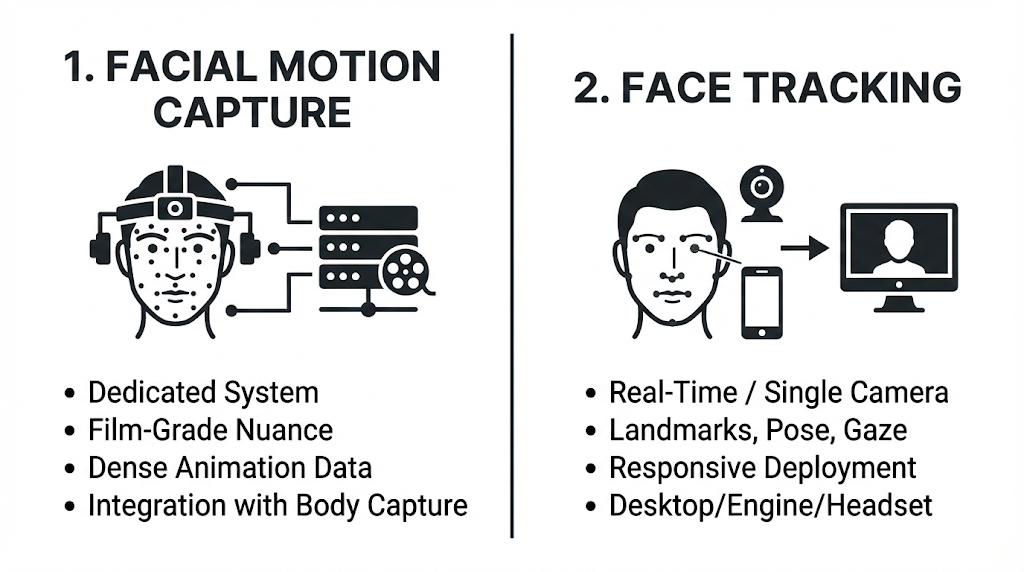
For VFX teams, that means the asset is not just modelled to look convincing in stills. It is prepared to move, emote and hold up in engine-based review, virtual production or performance-driven sequences. Mimic’s pipeline includes real-time facial and body motion capture, advanced rigging and skin deformation, so characters can be driven by performers and tested in context before final delivery.
Production challenges
Common production blockers
These are the issues teams usually want solved before a realtime asset can support a VFX pipeline.
01
Looks good, but does not perform
Characters can render well in stills yet fall apart once they need usable deformation, responsive facial motion or stable behaviour in an engine-based scene.
03
The asset arrives too late to be useful
VFX schedules often depend on early testing. If the character is not ready for motion capture, lighting checks or review, the team loses time.
02
Engine delivery is inconsistent
A production may need one asset to work across Unreal, Unity or other real-time tools, with textures, shaders and rigs prepared for practical handoff.
What your team gets
What this service helps VFX teams achieve
01
Production-ready characters
Assets are optimised with textures, shaders and rig integrations suited to real-time engines and character performance.
02
Better motion continuity
Facial and body capture support helps characters hold expression and movement across live or engine-led workflows.
03
Flexible pipeline fit
The service can support film, TV, commercials, virtual production and other screen-based use cases named in the source material.
04
Clearer handoff for teams
Delivery is focused on practical deployment in major real-time platforms rather than isolated asset creation only.
Capabilities and deliverables
Core capabilities

-
- 3D character optimisation. Discuss the target application and practical performance constraints.
-
- Real-time facial motion capture. Identify the expressions and close-up detail required by the performance.
-
- Real-time body motion capture. Plan the session around action references and performance requirements.
-
- Advanced rigging. Review proportions, range of movement and the animation handoff.
-
- Skin deformation support. Review proportions, range of movement and the animation handoff.
-
- Facial animation systems. Identify the expressions and close-up detail required by the performance.
-
- Unreal Engine integration. Discuss the target application and practical performance constraints.
-
- Unity integration. Discuss the required result and production scope during the project briefing.
Production approach
How the work fits into VFX
Mimic positions real-time assets as part of a broader character pipeline for screen work. The service can begin with a realistic avatar, digital double or creature build, then prepare that asset for engine testing, live performance or real-time previs-style use.
For VFX buyers, the practical considerations are clear: the rig must behave convincingly, the materials must read properly under lighting, and the asset must remain dependable when handed to a real-time team. The source also notes on-set or in-studio flexibility through portable scanning and mocap, plus the option to work at the client location or in the Berlin studio in Wedding. That makes the offer relevant where production needs character support, not only final-frame imagery.
The source material also shows scope that is useful to screen productions beyond games: digital doubles, fantastical creatures, full-body performance capture, and integration with Unreal Engine, Unity and other major platforms. Mimic notes experience building more than 50 human characters for Unreal Engine, plus work on the Robin Schulz music video produced entirely in Unreal Engine. For VFX buyers, the practical value is a character asset that can move from look development into a real-time stage, editorial review or on-set pipeline without unnecessary rework.
Specify the target application, camera distance and expected scene complexity. Review the asset in that context and agree responsibilities for optimisation, import and testing, including how materials and animation should behave in the final experience. For film and visual-effects work, include shot references and the relationship between digital characters and live-action footage.
Explore our Real-Time Assets services and VFX production.
Related production services: 3D Modeling for VFX · 3D Animation for VFX · Real-Time Assets for Gaming.


How we work
Typical delivery flow
01
Brief and technical scope
The team defines the character type, target engine, animation needs and intended use, such as virtual production, review or live performance.
02
Build and optimise the asset
Character geometry, materials, textures and rigs are prepared so the asset can perform reliably in a real-time environment.
03
Capture and test motion
Facial and body motion systems are integrated and checked for deformation, expression and movement quality.
04
Handoff for deployment
The final asset is delivered for the agreed engine or pipeline, with compatibility and performance tested before transfer.
Frequently asked questions
Frequently asked questions
Is this service meant only for games?
No. The source material explicitly positions real-time assets for film, TV, music videos, VR, virtual events and virtual production. For VFX teams, the main value is a character that can perform inside a real-time pipeline and support screening, review or capture workflows, not only interactive entertainment.
Can you supply a character that works in Unreal or Unity?
Yes. The service page states compatibility with Unreal Engine, Unity and other major real-time platforms. The asset is prepared with textures, shaders and rig integrations, then tested for lighting and frame performance so it can be deployed into the target environment with fewer technical surprises.
Do you provide motion capture as part of the asset work?
The source describes real-time facial and body motion capture systems as part of the offering. That means the character can be paired with live performance input, which is useful for VFX teams building scenes that need immediate motion, expression or virtual production interaction.
Can you help with digital doubles or creatures?
Yes. The VFX source specifically mentions photo-realistic digital doubles, cartoon characters and fantastical creatures. Realtime asset work can support those character types when they need to move through an engine-based pipeline and remain visually consistent during performance or review.
Do you work on location or only in Berlin?
The source says Mimic can travel with portable 3D scanning and mocap to a client’s preferred shoot location, including Babelsberg, or work from the Berlin studio in Wedding. That flexibility is useful when character capture needs to fit an existing production schedule or set.
How should a VFX team define scope before starting?
It helps to specify the intended engine, the final use case, whether the asset needs facial or full-body capture, and how much downstream integration is expected. The service is strongest when the handoff requirements are clear, because that shapes the rig, optimisation and performance testing from the outset.
Frequently asked questions