.png)
How VFX Studios Use AI for Digital Doubles
Updated: Aug 27
What actually changes when artificial intelligence enters the digital double pipeline for film and games?
AI does not replace the craft behind digital doubles. It speeds up parts of the pipeline that usually slow production down, including motion solving, facial passes, cleanup, and early previs. For film and game studios, that means faster iteration without sacrificing control over likeness, performance, or final quality.
The real value of AI digital double VFX film games workflows is not automation alone. It is the ability to move from capture to reviewable character work more efficiently while keeping scanning, rigging, animation, and rendering in expert hands.
Table of Contents
Why AI matters in digital double production
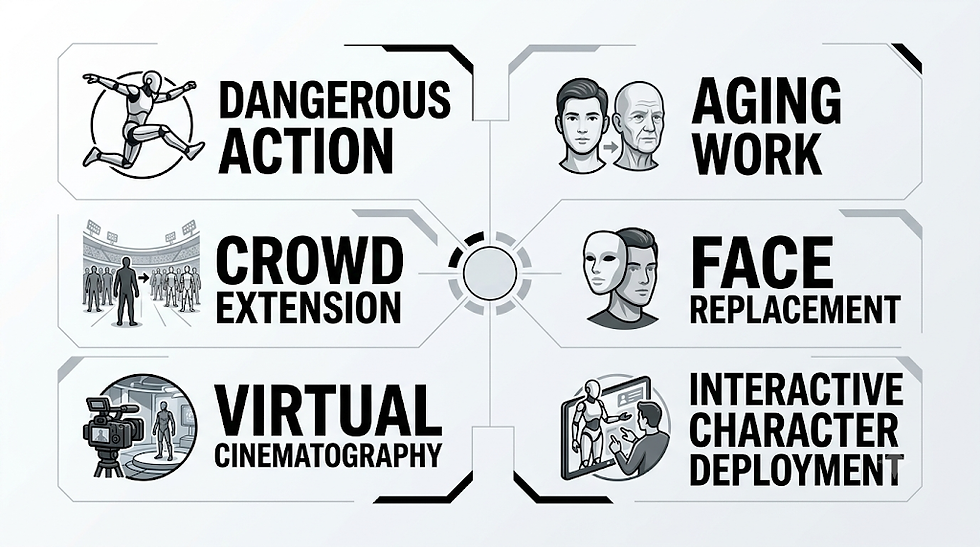
The modern digital double is no longer just an emergency stunt replacement. It is a production asset used for dangerous action, aging work, crowd extension, face replacement, virtual cinematography, interactive character deployment, and cross platform continuity between film marketing, games, and immersive experiences. Because those use cases multiply across departments, studios need faster ways to move from capture to reviewable shots.
This is where AI digital double VFX film games workflows are becoming useful. AI is strongest when it reduces friction between capture and iteration. Markerless solve systems can turn ordinary footage into motion data more quickly than stage based capture in some scenarios. Audio driven facial systems can generate a first facial pass from voice. Video to scene tools can estimate cameras, masks, and character passes for faster previs and layout. These capabilities are already being productized by Epic, Autodesk, and NVIDIA in ways that support existing DCC and engine pipelines rather than replacing them.
For studios building hero characters, this speed only becomes valuable when it feeds a robust asset foundation. That is why high fidelity doubles still begin with accurate scan capture and disciplined character construction. A pipeline that starts from 3D body scanning creates a far better base for likeness preservation than trying to invent a performer entirely from flat footage.
Where AI fits inside a real VFX pipeline

A credible pipeline usually starts with performer approval, legal clearance, capture planning, and reference acquisition. From there, teams move into scan processing, topology preparation, texture extraction, groom design, rig construction, look development, motion acquisition, retargeting, shot cleanup, lighting, and final rendering. AI touches several of these stages, but not all of them equally.
A practical breakdown looks like this:
Capture intake: AI can assist with segmentation, camera solving, plate prep, and markerless body tracking from monocular or consumer capture sources. Epic now documents single camera body capture alongside face capture, which lowers the barrier for rapid performance acquisition.
Facial motion generation: Depth solves, video based facial solve, and audio driven facial animation can speed first pass expression work. Epic’s documentation describes depth based processing and audio driven facial animation for realistic facial output. NVIDIA’s Audio2Face stack similarly focuses on converting audio into facial blendshapes and lip sync data.
Previsualization and blocking: Autodesk has highlighted a production case in which Boxel Studio used machine learning powered markerless motion capture for Superman & Lois, reducing work that previously took weeks to a matter of days for rapid previs and digital double iteration.
Retargeting and cleanup support: AI can provide useful first pass motion, but retargeting still depends on rig quality, joint logic, and animation cleanup. A poor facial rig or unstable body hierarchy will expose every solve artifact. That is why strong body and facial rigging remains central even in AI assisted production.
Real time deployment: Once performance data is stable, teams may push assets into Unreal or another runtime stack for previs, virtual production, marketing content, or interactive experiences. That handoff benefits from careful LOD planning, blendshape management, and runtime shader discipline. For this stage, realtime integration is not an afterthought. It is where film assets often need a second technical life.
Film workflows versus game workflows
Film and game teams both build believable digital humans, but they optimize for different conditions.
In film, the digital double may need to survive close focal lengths, path traced lighting, shot continuity, and editorial scrutiny. Accuracy of skin response, pore breakup, eye wetness, cloth behavior, and shot specific facial nuance matters enormously. AI is helpful in speeding base motion extraction and early facial timing, but final work still leans heavily on artist supervision, compositing logic, and offline render quality. Autodesk’s VFX overview still frames modeling, animation, compositing, lighting, shading, and rendering as core components of the discipline.
In games, especially for in engine cinematics or live character systems, the challenge shifts toward performance budgets, memory constraints, scalable rigs, and low latency animation. NVIDIA ACE explicitly emphasizes small models, on device inference, and scheduling AI inference alongside graphics workloads. That makes AI especially attractive for dialogue driven NPCs, live service character systems, and responsive facial animation layers.
This is why AI digital double VFX film games pipelines diverge after capture. Film pipelines tend to use AI as an acceleration layer before artist refinement and offline finishing. Game pipelines more often keep AI active deeper into runtime behavior, voice response, or live facial performance. Teams building for both spaces need a character asset that can move between cinematic fidelity and interactive efficiency, which is exactly where photo realistic 3D character models become strategically important.
What AI accelerates well and what still needs artists

AI is extremely good at pattern recognition across large volumes of performance data. It can estimate motion, infer lip sync, suggest expression timing, segment performers, rebuild rough scene logic, and shorten the path from raw footage to reviewable animation. That makes it useful in at least five places:
Fast previs for directors and supervisors
First-pass body solve from limited capture setups
Speech-driven facial motion for temporary or scalable dialogue content
Large-volume variation for background or secondary characters
Repetitive cleanup assistance in early production rounds
But there are still areas where artist judgement remains decisive:
Likeness fidelity: A recognisable face is not just proportion. It is soft tissue motion, asymmetry, eye focus, skin response, and micro timing.
Deformation quality: No AI solve fixes a weak rig. Shoulder collapse, lip pinching, eyelid penetration, and jaw volume loss still demand technical character expertise.
Look development: Subsurface response, roughness breakup, peach fuzz behavior, groom silhouettes, and cloth shading are not solved by a prompt.
Shot intent: Animation is not only about reproducing motion. It is about selecting the right motion for the camera, edit, and emotional beat.
Ethical control: Consent, data provenance, performer approval, and usage boundaries require human governance, not automation.
A studio offering VFX services should therefore treat AI as a pipeline accelerant, not a substitute for production judgement.
The consent, likeness, and performance question
Digital doubles sit close to identity. That makes ethics inseparable from workflow. A credible studio needs performer consent, likeness approvals, controlled capture handling, clear scope of usage, and careful distinction between authorized digital performance and synthetic imitation. This is not only a legal concern. It is a creative one. Performers and rights holders need confidence that a digital replica will not drift away from the approved brief.
The strongest studios build these safeguards into the process itself. Capture is documented. Source material is controlled. Likeness targets are agreed early. Review points are formalized. Facial performance is not treated as disposable data. The Mimic Productions knowledge base is explicit that digital human creation should be ethical, consent driven, and rooted in real production practice rather than generic AI rhetoric.
That becomes even more important as AI digital double VFX film games work expands beyond hero shots into persistent character ecosystems, live marketing assets, and interactive brand characters. Once the same likeness appears across film, game, XR, and promotional media, governance matters as much as rendering.
Why studios are combining AI with capture craft instead of replacing it

The most useful way to understand the current moment is this: AI reduces setup friction, not authorship. A performer can be scanned once, rigged once, and then reused across many outputs, but every output still has its own technical and aesthetic requirements. A game cinematic may tolerate different facial density and cloth logic than a film close up. A virtual production previs pass may prioritise speed, while a hero VFX shot prioritises fine deformation and compositing edge quality.
That is why many teams still combine markerless AI workflows with traditional motion capture, supervised facial solve, manual animation cleanup, and rendering passes tuned to the destination medium. Even Autodesk’s current positioning of Flow Studio stresses controllable CG scenes and export ready output for further refinement, not fully automated finaling.
For game production, the same logic applies in another form. AI can help create dialogue responsive characters faster, but runtime success still depends on animation compression, skeleton strategy, LOD behavior, and engine side optimization. When the end target is not just a cinematic but a playable experience, the pipeline must stay grounded in the realities of gaming production.
Comparison Table
Stage | Traditional | AI-Assisted | Human Craft |
Performance Capture | Optical or inertial stage capture | Markerless body and face solving | Supervision, calibration, retargeting |
Facial Animation | Keyframing or facial capture | Video, depth, or audio-driven passes | Emotion, accuracy, likeness |
Previs and Layout | Manual blocking | Faster camera and character passes | Staging, rhythm, storytelling |
Character Creation | Modeling, grooming, surfacing, rigging | Faster cleanup and iteration | Topology, rigs, shaders, cloth |
Film Delivery | Offline rendering and compositing | Faster inputs for refinement | Lighting, compositing, realism |
Game Delivery | Hand-authored runtime animation | AI facial and conversational motion | Optimization, latency, integration |
Applications

Stunt replacement in film: AI-accelerated motion extraction can shorten the path from body performance to a reviewable digital double, especially during previs and action planning.
Hero cinematics in games: Facial solving and audio-driven animation can help teams scale dialogue content while preserving a consistent performance style.
Cross-media character continuity: A single performer-derived asset can move between film shots, trailers, promotional content, and immersive experiences when the underlying character build is robust.
Virtual production and on-set review: Rapid body and facial solving makes it easier to test blocking, digital framing, and editorial timing before investing in final post-production.
Interactive digital humans: In-game assistants, conversational characters, and live-driven avatars benefit from AI systems designed for low-latency animation and real-time response.
Benefits

Faster early-stage iteration without waiting for a full finishing pass
Lower barrier for prototype performance capture in selected scenarios
Better previs velocity for directors, supervisors, and game teams
Scalable dialogue animation for interactive characters
More efficient movement from footage to editable animation assets
Stronger continuity between offline and real-time character workflows when the asset foundation is properly built
The core benefit of AI digital double VFX film games pipelines is not automation for its own sake. It is the ability to compress the distance between capture, review, and revision without losing control of the character.
Future Outlook
The next phase of digital double work will likely be defined by convergence. Film pipelines are borrowing real time review habits from games. Games are borrowing performance standards from film. AI is accelerating that convergence by making body solve, facial solve, speech response, and scene reconstruction more accessible across both worlds.
Epic’s current tooling already points toward broader capture accessibility through single camera body and face workflows, while NVIDIA’s stack points toward runtime characters that can speak, animate, and react inside game environments. Autodesk’s recent positioning around markerless motion capture and video to 3D scene generation suggests that footage ingestion itself will continue to become faster and more controllable.
But the studios that benefit most will not be the ones chasing full automation. They will be the ones with the best hybrid discipline: high quality scan data, stable rigs, strong animation supervision, engine aware deployment, and clear ethical governance. In other words, the future belongs to pipelines where AI accelerates craftsmanship rather than pretending to replace it.
FAQs
What is an AI digital double in VFX?
An AI assisted digital double is a computer generated replica of a performer or character whose pipeline uses machine learning tools to speed up stages such as motion extraction, facial solving, speech driven animation, segmentation, or previs. The final asset still depends on scanning, surfacing, rigging, animation, and rendering craft.
Is AI replacing motion capture for film and games?
Not completely. In some contexts, markerless systems reduce the need for a full capture stage, especially for previs or constrained production setups. But high value character work still benefits from supervised capture, retargeting control, and animation cleanup.
Can AI create a final quality digital double from one video?
Not reliably for hero work. A single clip may produce usable motion or rough scene data, but close up likeness, stable deformation, production level skin, groom quality, and shot specific polish still require a full character pipeline. Autodesk’s own messaging around Flow Studio emphasizes controllable, export ready scenes rather than finished hero assets.
How is film use different from game use?
Film tends to prioritize shot fidelity, comp integration, and offline rendering detail. Games prioritize runtime efficiency, latency, scalable dialogue animation, and engine side optimization. NVIDIA ACE reflects that runtime focus directly through on device inference and graphics aware scheduling.
Why are scanning and rigging still important if AI is involved?
Because AI can estimate performance, but it cannot guarantee a production worthy character foundation. Scan accuracy protects likeness. Rigging protects deformation. Without those, solve data will expose problems rather than hide them.
What should studios watch from an ethics perspective?
Consent, likeness rights, source data handling, review approvals, usage boundaries, and clarity around what is captured versus synthetically generated. For digital doubles, technical capability is only half the job. Governance is the other half.
Conclusion
AI is changing digital double production, but not in the simplistic way most headlines suggest. The real shift is operational. VFX studios and game teams can move faster from footage to editable motion, from dialogue to facial pass, and from rough capture to reviewable character work. That is valuable. But it only becomes production ready when it sits on top of careful scanning, disciplined rigging, animation judgement, and clear performer consent.
For studios working across entertainment, the winning model is hybrid. Use AI where it shortens repetitive or time sensitive stages. Keep artists in control of likeness, deformation, staging, and final performance. That is the difference between a fast result and a believable one. In AI digital double VFX film games production, speed matters, but credibility matters more.
For inquiries, please contact: Press Department, Mimic Productions info@mimicproductions.com


Comments