.png)
Embodied AI vs. Physical AI
Updated: Aug 31

What changes when intelligence gets a body?
The conversation around Embodied AI vs. Physical AI matters because these two ideas are often treated as if they were interchangeable. They are not. One concerns intelligence shaped by presence, perception, action, and feedback Embodied AI vs. Physical AI: Kthrough a body. The other concerns intelligence that must operate inside the hard constraints of the physical world, where gravity, force, friction, timing, and safety are no longer abstract variables but daily operating conditions.
This distinction becomes especially important when teams move from screen based characters to deployed systems. A believable digital person can exist inside photoreal digital humans, games, live experiences, XR environments, or branded interactions without ever touching a motor, wheel, or robotic arm. A machine in the real world has a very different burden. It must sense correctly, decide quickly, move reliably, and recover when the environment behaves in unexpected ways.
For studios, brands, and product teams, the difference is not academic. It shapes the entire pipeline. It changes how you capture performance, design behavior, evaluate risk, define realism, and measure success. In digital character work, embodiment is often social, visual, and performative. In real world systems, embodiment becomes mechanical, spatial, and safety critical.
Table of Contents
Why the distinction matters

There is a practical reason this distinction keeps resurfacing. AI has moved beyond text generation and classification. It now appears in characters, agents, assistants, robots, simulators, and live interactive systems. Once intelligence is expected to act through a body, even a virtual one, design choices stop being purely computational. Timing, motion, gaze, spatial awareness, responsiveness, and user trust become part of the system itself.
That is why production teams cannot treat embodiment as a visual layer added after the fact. In film, games, XR, and live virtual characters, the body is part of the intelligence loop. If the face reacts too late, if gesture and speech fall out of sync, or if gaze misses the point of interaction, the audience experiences a break in presence. The system may still be technically functional, but it no longer feels coherent.
In physical deployment, the consequences are harsher. A character that misses emotional timing can feel artificial. A machine that misses object position, force tolerance, or collision boundaries can fail operationally. The distinction matters because one category is judged primarily by believability and interaction quality, while the other is judged by reliability in contact with the real world.
Embodied AI vs. Physical AI in Plain Terms

The clearest way to separate these concepts is this: embodied intelligence refers to AI that understands and acts through a body, whether that body is virtual, simulated, or physical. Physical intelligence refers to AI that must function through an actual machine body in the real world.
In other words, physical intelligence can be treated as the stricter operational subset. Every physical system is embodied in some form because it must sense, decide, and act through a material form. Not every embodied system needs hardware. A digital human in a real time engine is still embodied because expression, voice, gesture, timing, and spatial response all shape how intelligence is perceived and how interaction unfolds.
This is where many comparisons go wrong. They assume embodiment begins only when motors and actuators enter the picture. In production reality, embodiment starts much earlier. It begins when intelligence must perform through presence. A virtual performer, a conversational character, or a lifelike assistant can all be embodied systems even when their body is made of rigging, shaders, animation logic, and runtime behavior rather than metal, plastic, and servo control.
Embodiment in digital humans begins before behavior
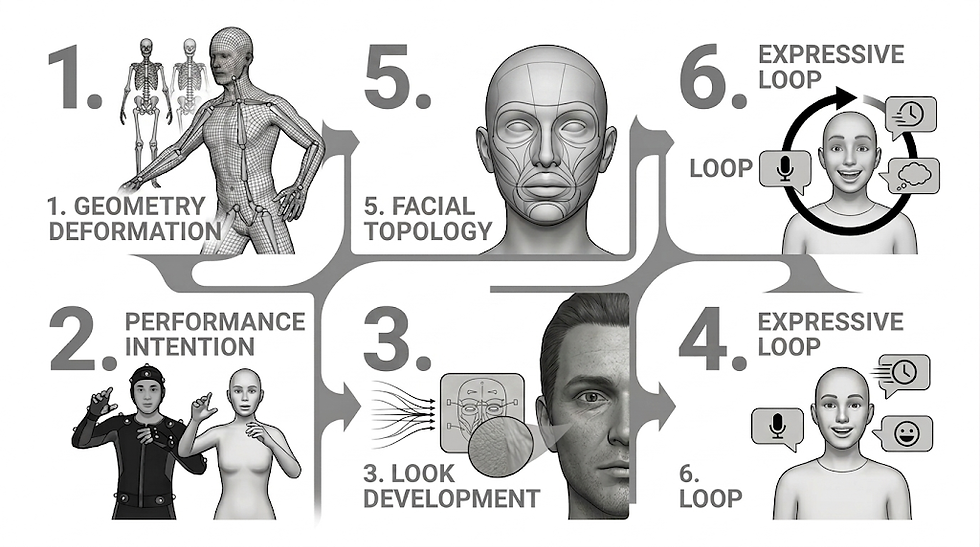
For digital humans, embodiment does not start with a language model. It starts with the body itself. A believable character requires geometry that deforms properly, facial topology that can support subtle expression, a rig that preserves intention across the face and body, textures that hold under close inspection, and timing that feels responsive rather than mechanical.
That is why the pipeline matters. Scanning, topology cleanup, facial setup, rig logic, look development, performance transfer, animation cleanup, and rendering strategy all shape whether intelligence can feel present on screen. A system can generate excellent text and still fail as an embodied character if the eyes do not settle correctly, the pause before a reply feels wrong, or the body language contradicts the spoken intention.
This is also where conversational character systems change the equation. Once a digital person is expected to interpret speech, maintain context, and respond with tone, timing, and personality, intelligence is no longer isolated from performance. It becomes part of a live expressive loop.
Performance input remains equally important. A strong motion capture pipeline does more than record movement. It preserves nuance, weight, rhythm, and asymmetry that audiences read instinctively. Even when AI drives part of the response, the body still needs a movement language grounded in human observation. That is one reason digital humans sit at the heart of embodied systems even when no physical hardware is present.
Digital humans are embodied without being mechanical

A digital human can be embodied because people respond to bodies before they respond to abstract intelligence. We read posture, gaze, breathing rhythm, turn taking, facial tension, and gesture coherence almost instantly. When those signals align, the system feels present. When they do not, users withdraw trust.
This is why digital embodiment is not a cosmetic layer. It is a behavioral interface. In a production setting, the face rig, the animation system, the voice model, the response engine, and the runtime all influence cognition as experienced by the audience. A delay of a few hundred milliseconds can undermine perceived intelligence. So can mismatched lip timing, a dead stare, repetitive gesture loops, or physically implausible transitions.
From a studio perspective, embodiment in digital humans is often about coherence across layers. The model must hold close up. The rig must support performance. The animation must preserve intent. The runtime must remain responsive. The voice must match the emotional register. The intelligence must know when to speak, when to pause, and when to defer. That is not just a design challenge. It is a systems problem.
Physical intelligence begins where simulation stops protecting you

Physical intelligence carries all of the complexity of embodiment and then adds real world consequence. A robot or autonomous machine cannot rely on the audience to forgive a slightly strange gesture. It must interpret sensor data, localize itself, understand space, predict change, plan action, and execute movement with enough consistency to complete a task safely.
This is where the real divide appears. A digital human can sometimes cheat. Lighting can be art directed. Performance can be cleaned. Animation can be refined. Offline rendering can elevate realism. Even live systems can hide some complexity behind controlled staging. A physical system cannot cheat contact. If it misjudges grip, distance, speed, load, or balance, the failure is immediate.
That is why real time deployment architecture is far more demanding in physical environments. The loop between sensing, decision, and action must remain stable under uncertainty. Latency, drift, occlusion, noisy inputs, actuator limits, thermal conditions, and edge cases all become first order concerns. A robot does not live inside a polished render. It lives inside friction, clutter, and incomplete information.
Physical systems are judged by control, not just presence

A lifelike presence can help a physical system communicate, but physical intelligence is ultimately evaluated by what it can do. Can it grasp reliably. Can it navigate changing space. Can it avoid people and obstacles. Can it recover from error. Can it handle variable inputs without constant human correction.
That is why physical systems depend heavily on simulation, world models, control policy training, sensor fusion, state estimation, and failure recovery logic. The problem is not only perception. It is action under consequence. A manipulator arm, a warehouse platform, a service robot, or an autonomous inspection system must convert reasoning into motion that works in the world as it is, not the world as the model hoped it would be.
This is the point where robotics practice becomes central. The body is no longer representational. It becomes operational. The intelligence must be measurable in throughput, precision, safety margin, recovery behavior, and long term reliability. Presence still matters, especially in human facing robotics, but competence matters more.
Where virtual and physical systems overlap

Despite their differences, these two domains share a growing amount of infrastructure. Both rely on perception. Both depend on memory, context, and decision logic. Both benefit from simulation. Both require careful runtime design. Both must align action with intention. Both are ultimately judged by whether the body makes the intelligence legible.
That is why digital humans are becoming useful testbeds for interaction logic. A virtual body can reveal whether an agent interrupts too often, misreads attention, handles silence poorly, or breaks user trust before the same logic ever reaches physical hardware. In many cases, a screen based agent is the safest place to refine social behavior, turn taking, emotional pacing, and context handling.
The reverse is also true. Work in physical systems pushes virtual systems toward better grounding. When engineers think in terms of spatial reasoning, scene awareness, contact, timing, and consequence, digital character design becomes more disciplined. The result is a more mature understanding of embodiment across both fields.
Why this distinction matters in production

For production teams, the benefit of separating these concepts is clarity. If the goal is a digital brand ambassador, a virtual performer, a customer facing assistant, or an interactive character, the central challenge is embodied presence. The pipeline should prioritize capture quality, character fidelity, rig robustness, behavioral coherence, and response timing.
If the goal is a machine that must perform in the world, the core challenge changes. Mechanical design, sensors, control systems, safety logic, simulation fidelity, and robustness dominate the stack. Visual realism may still matter, especially for human facing interfaces, but it is not the system’s primary burden.
This distinction also protects budgets and expectations. Teams often overestimate what visual embodiment can do for physical competence, or underestimate how much production craft is required to make a digital human feel genuinely present. Separating the two keeps strategy honest. It tells you whether you are building for performance, for operation, or for a hybrid of both.
Comparison Table: Embodied AI vs. Physical AI
Dimension | Embodied AI | Physical AI |
Primary definition | Intelligence expressed through a body, including virtual and simulated bodies | Intelligence deployed through a real machine body in the physical world |
Typical form | Digital humans, virtual agents, game characters, XR assistants | Robots, autonomous platforms, industrial systems, service machines |
Main challenge | Believability, presence, timing, interaction quality | Reliable sensing, control, planning, safe execution |
Core constraints | Latency, animation coherence, expression fidelity, user trust | Force, friction, collision, uncertainty, hardware limits, safety |
Pipeline emphasis | Scanning, rigging, animation, rendering, behavior design, runtime response | Sensors, simulation, control, policy training, world models, recovery logic |
Environment | Screen based, simulated, game engines, XR, live digital performance | Factory floor, warehouse, retail, healthcare, public space, field operation |
Failure mode | Loss of presence, reduced trust, awkward performance, uncanny interaction | Task failure, collision risk, instability, unsafe behavior, operational downtime |
Success metric | Natural interaction, emotional credibility, behavioral coherence | Task completion, precision, repeatability, resilience, safety margin |
Human role | Audience, user, performer, participant, operator | Supervisor, coworker, end user, technician, safety authority |
Ethical focus | Likeness rights, consent, disclosure, emotional trust | Safety, accountability, override, traceability, public trust |
Applications

Digital humans and interactive characters: Embodied systems are already central to virtual presenters, branded assistants, training characters, game NPCs, and live digital talent. In these cases, success depends on body language, visual quality, contextual response, and a strong relationship between voice, face, and motion.
Film, advertising, and entertainment pipelines: Studios use embodied systems to bridge performance capture, facial animation, look development, and real time interaction. This is especially important when a character must move between cinematic quality assets and live runtime environments without losing identity or expressive clarity.
Customer experience and guided interaction: When a business needs a human facing interface, embodiment often matters more than raw model output. A visible character can guide attention, structure a conversation, and create emotional continuity. That is one reason teams building service experiences increasingly combine AI logic with carefully designed character presence rather than relying on text alone.
Real world automation and machine assistance: Physical systems become essential when intelligence must manipulate objects, navigate dynamic environments, monitor sites, or support operational workflows. In these settings, appearance is secondary to task reliability, though human readable behavior remains important for trust and safety.
Hybrid systems across spatial computing: The most interesting deployments sit between these categories. A digital human may act as the visible interface for a physical backend. A virtual instructor may train users on processes later executed by machines. A character inside an XR workflow may represent a system that is partly simulated and partly connected to real devices. This middle ground is where the two fields increasingly meet.
Benefits

Clearer design decisions: Separating virtual embodiment from physical deployment helps teams choose the right stack, the right specialists, and the right evaluation criteria.
Better production planning: A digital human project needs strong asset creation, rigging, animation, voice, and runtime coordination. A physical system needs sensing, control, testing, and safety engineering. Confusing the two leads to weak planning.
Stronger user experience: Embodied character systems improve when teams treat presence as a core function rather than decoration. Physical systems improve when teams treat human readability as part of operational design.
More honest expectations: A beautiful character does not guarantee grounded behavior. A capable robot does not automatically create a comfortable human interaction. This distinction keeps both ambitions realistic.
Better ethical framing: Digital humans require careful treatment of consent, likeness, and disclosure. Physical systems require accountability, supervision, and safety boundaries. The ethical questions overlap, but they are not identical.
Future Outlook
The future will not be a winner take all contest between virtual embodiment and physical deployment. It will be a convergence of layers. Digital humans will continue to evolve as high fidelity interfaces for communication, performance, education, and brand interaction. Physical systems will continue to improve in manipulation, navigation, autonomy, and decision making under uncertainty.
What changes next is the degree of shared infrastructure. Simulation, world modeling, memory, multimodal perception, and real time orchestration will increasingly serve both domains. A character in a virtual space and a machine in a warehouse may rely on different bodies, but they will draw from more connected intelligence architectures than most teams assume today.
The most capable systems will be the ones that understand embodiment as more than appearance. They will treat the body as a decision surface, an interaction surface, and a trust surface. In digital humans, that means performance with coherence. In physical systems, it means action with consequence. In both, it means intelligence that can be felt through behavior rather than merely described by output.
FAQs
What is the difference between Embodied AI vs. Physical AI?
Embodied intelligence is the broader concept. It describes AI that acts through a body, including virtual and simulated bodies. Physical intelligence is the stricter case where that body exists in the real world and must function under mechanical and environmental constraints.
Is a digital human an embodied system even without hardware?
Yes. If a digital human perceives, responds, gestures, speaks, and maintains presence through a body in an interactive loop, it is embodied in a meaningful production sense. The body may be virtual, but it still shapes how intelligence is experienced.
Is physical intelligence only about robots?
Robots are the clearest example, but not the only one. Any machine system that senses the world and acts within it through physical components belongs in this category. The defining feature is not the robot label. It is real world operation under physical constraint.
Which is harder to deploy?
Physical systems are usually harder to deploy because the world does not pause for correction. They must deal with noise, uncertainty, collision risk, wear, and recovery. Digital embodied systems are easier to stage, but they are still difficult to make believable at a high level.
Why should studios and brands care about this distinction?
Because it prevents category errors. It helps teams understand whether they are solving for performance, interaction, operation, or a hybrid combination. That changes how they budget, prototype, staff, and evaluate success.
Conclusion
The most useful way to think about this space is not through buzzwords, but through bodies, constraints, and outcomes. A digital human, a virtual assistant, and a robot may all involve AI, but they do not ask the same thing of intelligence. One may need to perform convincingly. Another may need to act safely. The strongest systems know which burden they carry.
As the field matures, the line between virtual embodiment and real world operation will become more connected, but not less important. Teams that understand the distinction early can build with more precision, choose the right pipeline, and create systems that feel coherent because their intelligence matches the body that carries it.
For inquiries, please contact: Press Department, Mimic Productions info@mimicproductions.com
Building an Embodied AI Experience?
Mimic creates expressive digital humans and AI avatars designed for real-time interaction, branded communication, training and immersive customer experiences.


Comments