.png)
AI Video Generators vs. Real-Time Digital Humans
Updated: Sep 24
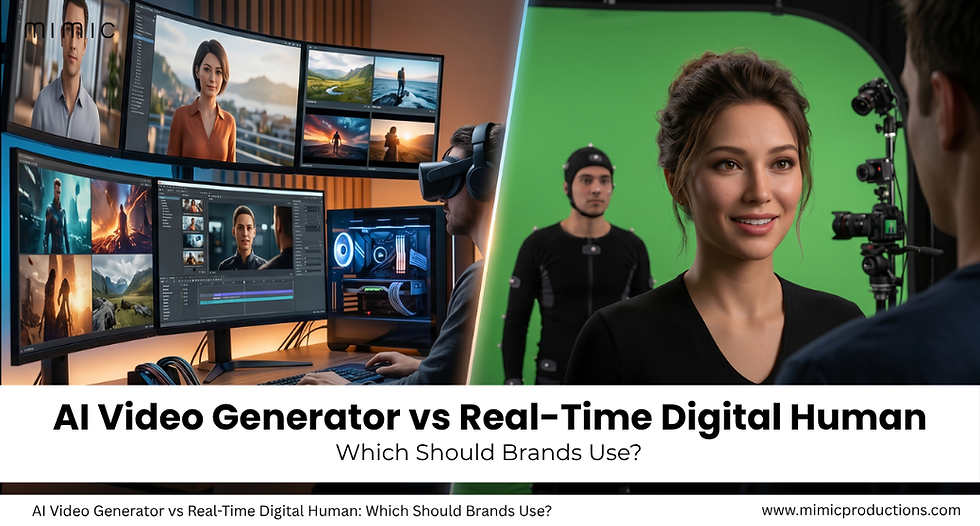
Should a brand choose speed, or should it choose presence?
That question sits at the center of the decision between an AI video generator and a real time digital human. Both can put a human likeness on screen. Both can help brands scale communication. But they are not built for the same job, and treating them as interchangeable usually leads to the wrong production choice.
The difference is not just visual quality. It is about interaction, performance, control, pipeline depth, and what the audience is expected to do next. A one way synthetic video can deliver a scripted message efficiently. A live digital human can respond, adapt, and participate in a conversation inside a real time environment. For a brand, that difference affects customer experience, trust, production planning, and long term asset value.
In this guide, we break down AI Video Generator vs Real Time Digital Human from a production and brand perspective. We will look at how each format works, where each one performs best, and why premium brands increasingly separate quick synthetic video output from fully interactive character systems. Where the goal is a credible, high fidelity virtual presence, the conversation moves beyond templates and toward digital human craft.
Table of Contents
What an AI video generator actually does

An AI video generator is designed to produce video content from scripts, prompts, audio, or structured templates. In most cases, the output is linear. The character delivers a message. The viewer watches it. The experience ends there.
For many brands, that is useful. It can reduce production overhead for internal communication, product explainers, multilingual updates, training content, and campaign variations. A marketing team can create multiple versions quickly without booking a shoot, building a full CG asset, or running a motion capture session.
That convenience, however, comes with constraints. Most AI video systems are optimized for fast content generation rather than deep character fidelity. Facial motion is often inferred rather than performed. Body language is limited. Emotional nuance tends to flatten under repetition. The result may be efficient, but it is rarely built to carry the weight of a premium brand presence over time.
This is where many teams misread the category. They see a synthetic presenter and assume they are already in digital human territory. In production terms, they are not. A generated spokesperson is still a rendered output, not a responsive character system.
What a real time digital human actually is

A real time digital human is not simply a face on screen. It is a fully built character asset designed to operate inside an interactive pipeline. That usually involves character design, scanning or model creation, facial rigging, body rigging, material development, animation logic, real time rendering, and a system for live or dynamic response.
At the high end, this work draws from the same disciplines used in film, games, XR, and virtual production. The character may be connected to live performance capture, conversational AI, or engine based deployment. That means the digital human is not just presenting information. It can react, respond, and exist as part of a live branded experience.
For brands that want believable identity, this difference matters. A properly built character has continuity across touchpoints. It can appear in product launches, immersive activations, customer engagement environments, and interactive retail. It becomes infrastructure, not just output.
That is why brands exploring premium character work often move toward AI avatars only after clarifying whether they need a static presenter or a responsive digital presence.
Why brands often confuse the two

The confusion is understandable. On the surface, both formats may look similar in a short demo. Both feature a synthetic person. Both may speak naturally enough for casual viewing. But the production logic underneath is completely different.
An AI video generator is typically designed for one directional delivery. It excels when the message is known in advance and the viewer is passive. A real time digital human is designed for dynamic interaction. It becomes valuable when the audience needs to ask, explore, respond, or remain engaged across sessions.
The confusion also comes from how the market talks about avatars. The same vocabulary is often used to describe template based video presenters, conversational assistants, virtual influencers, and cinematic digital humans. From a studio perspective, these are distinct classes of asset. They differ in rig complexity, shading quality, input systems, deployment context, and performance expectations.
For serious brand work, the correct question is not which one looks futuristic. The correct question is what the brand needs the character to do.
AI Video Generator vs Real Time Digital Human in production terms

When comparing AI Video Generator vs Real Time Digital Human, the biggest divide is not automation. It is agency.
An AI video generator produces a finished clip. A real time digital human participates in an experience.
That distinction changes everything upstream. A generated video can often be made from a script, voice track, and a preset visual identity. A real time character usually requires a deeper build process. The team may need facial topology designed for expression range, performance ready rigs, optimized shaders for engine use, and integration layers for interactive behavior. In many cases, the most successful systems also rely on real time integration so the character can operate reliably across live environments, installations, or responsive digital experiences.
This is also where production quality becomes visible. Brands with a premium visual standard tend to notice the difference quickly. One way AI videos can feel acceptable in isolation, but they often break under closer scrutiny or repeated use. Real time digital humans, when built properly, are designed to withstand proximity, repetition, and audience interaction.
Visual realism is not the same as character credibility

Many buyers evaluate these tools by asking which one looks more realistic. That is too narrow.
Visual realism matters, but credibility comes from the full performance stack. Skin response, eye focus, timing, micro expression, rig behavior, voice synchronization, and conversational pacing all shape whether a digital person feels present or merely assembled.
In a generated video, realism can be front loaded into the frame, but it may not survive variation. Once the audience asks an unexpected question or sees the character across multiple use cases, the illusion weakens. In a real time system, the burden shifts from static image quality to behavioral consistency. That is a harder problem, but it is the one that matters for long term deployment.
This is why the asset foundation matters. Premium character systems depend on robust modeling, surfacing, and deformation. For brands pursuing that standard, 3D character services are not an optional add on. They are the basis of whether the character will hold up in production.
Interactivity changes the brand value equation
A generated video is content. A real time digital human is capability.
That difference has strategic consequences. Content is consumed and replaced. Capability can be reused, extended, and integrated into multiple brand systems. A digital human that exists as an interactive asset can support customer engagement, retail assistance, live demonstration, experiential media, and virtual brand representation across platforms.
This is where AI Video Generator vs Real Time Digital Human becomes a business decision, not just a creative one. If the brand only needs scaled video output, the generator may be enough. If the brand wants two way communication, dynamic customer journeys, or a consistent synthetic representative that can evolve over time, the investment logic changes.
When conversation becomes part of the experience, the character must connect to intelligence as well as appearance. In those cases, conversational AI systems become central to the design, because the audience is no longer watching a message. They are interacting with a branded entity.
Performance capture, motion logic, and why embodiment matters
Another important distinction is how motion enters the system. Many AI video tools infer motion from existing models. That can work for simple delivery, but it often lacks the physical specificity required for a convincing premium character.
Real time digital humans benefit from performance driven inputs. That may include facial capture, body motion capture, hand data, or animation layers shaped for live playback. Even when the end result is stylized, the underlying performance carries intention. Timing becomes more human. Expression becomes more specific. The character stops feeling like a mouth attached to a script.
For brand environments that require live presence, presentation, or nuanced expression, a strong motion capture pipeline can be the difference between novelty and credibility.
Where an AI video generator makes sense

There are real cases where the simpler tool is the right tool.
A brand should consider an AI video generator when the goal is:
High volume campaign localization
Internal communications at scale
Scripted product explainers
Fast message testing across markets
Short form content where interaction is not required
Temporary use cases with limited asset lifespan
In these situations, a generated presenter can be efficient and cost aware. The key is to evaluate it honestly. It is a production shortcut for linear communication, not a substitute for a premium digital human pipeline.
Where a real time digital human makes sense

A brand should consider a real time digital human when the goal is:
Interactive customer experience
Live event activation
High fidelity branded presence
Virtual ambassadors with continuity across channels
Retail, hospitality, or showroom experiences
XR and immersive storytelling
Premium synthetic talent that must feel authored, not templated
These are environments where the audience expects response, presence, and consistency. In those settings, AI Video Generator vs Real Time Digital Human is not a close contest. The real time character exists for a different class of experience.
Comparison Table
Category | AI Video Generator | Real Time Digital Human |
Primary function | Creates linear scripted video output | Supports live or dynamic interaction |
User experience | One way viewing | Two way engagement |
Production depth | Template led or automation led | Built through character pipeline development |
Motion quality | Usually inferred or limited | Can be driven by capture, rig logic, and authored animation |
Brand continuity | Useful for campaigns and variations | Useful as a persistent brand asset |
Best for | Explainers, updates, localization, training | Customer experience, immersive media, premium activation |
Scalability | Fast content scale | Slower to build, stronger long term reuse |
Creative control | Moderate, depending on the platform | High, especially with studio led asset creation |
Audience expectation | Watch and move on | Engage, ask, respond, return |
Applications

Marketing and campaign production
For campaign content, the answer depends on whether the character is serving the message or carrying the brand. If the goal is speed, language adaptation, and frequent variation, an AI video generator can be practical. If the goal is to establish a recognizable digital spokesperson with a premium visual signature, a real time digital human creates more long term value.
Retail and customer experience
Retail is one of the clearest dividing lines in the AI Video Generator vs Real Time Digital Human discussion. A pre rendered presenter can explain. A real time character can greet, guide, answer, and adapt. In a physical or digital storefront, that difference is enormous because the audience is not just consuming media. They are moving through a decision journey.
Events and immersive activations
Live environments reward responsiveness. Whether the format is XR, a branded installation, or a public activation, a real time character can create presence in a way prerecorded synthetic video cannot. Timing, audience participation, and environmental responsiveness all matter more than simple playback.
Premium advertising and branded storytelling
Luxury, entertainment, and innovation led brands usually need more than functional delivery. They need characters that feel authored, intentional, and visually coherent across multiple touchpoints. In these cases, a digital human supported by cinematic craft tends to outperform quick generation tools because the work is measured not just by speed, but by believability and control.
Benefits

Benefits of using an AI video generator
Rapid content creation
Easier localization and script iteration
Lower production overhead for simple messaging
Useful for internal and short-cycle communication
Benefits of using a real time digital human
Stronger audience engagement
Better fit for interactive and immersive experiences
More control over identity, movement, and quality
Greater long-term asset value across campaigns and platforms
Clearer differentiation for brands that care about craft and realism
In the broader AI Video Generator vs Real Time Digital Human decision, the generator wins on speed. The digital human wins on depth.
Future Outlook
The market will keep using both.
AI video generators will become more common inside marketing operations because they solve a real production bottleneck. They are likely to improve in facial coherence, multilingual delivery, and automation. For straightforward communication tasks, they will remain useful.
But the future of branded digital presence will move toward responsive characters, not just synthetic clips. As real time engines, conversational systems, and performance driven animation become more accessible, brands will expect digital people to do more than speak on cue. They will need to listen, respond, and inhabit environments with greater credibility.
That is why the future is not about replacing one format with the other. It is about understanding the level of embodiment the brand actually needs. In the long run, the strongest digital human work will come from pipelines that combine authored character creation, real time deployment, intelligence layers, and ethical control over likeness and performance.
For brands aiming at that level, the question of AI Video Generator vs Real Time Digital Human becomes a question of ambition. One produces content. The other builds a presence.
FAQs
What is the main difference between an AI video generator and a real time digital human?
The main difference is interaction. An AI video generator creates a finished video for passive viewing. A real time digital human is designed to respond, adapt, and function inside an interactive experience.
Is an AI video generator cheaper than a real time digital human?
Usually, yes in the short term. A generator is often faster and less complex to produce with. A real time digital human typically requires deeper character development, technical integration, and production planning, but it can deliver more long term value.
Which option is better for premium brands?
For premium brands, the answer depends on the use case. Scripted updates and campaign variations may work well with a generator. Brand experiences that depend on realism, continuity, and interaction are better served by a real time digital human.
Can a brand use both?
Yes. Many brands should. A generator can support operational content, while a high fidelity digital human can anchor customer facing experiences, activations, or flagship campaigns. In a mature strategy, AI Video Generator vs Real Time Digital Human is not always an either or decision.
Why does production quality matter so much in digital humans?
Because viewers notice inconsistency quickly. If expression, shading, timing, or movement break the illusion, trust falls with it. High quality character production protects brand perception, especially when the audience spends more than a few seconds with the asset.
When should a brand move beyond simple avatar tools?
A brand should move beyond simple avatar tools when it needs a persistent digital representative, interactive conversation, premium realism, or deployment across multiple channels and environments.
Conclusion
For brands deciding between AI Video Generator vs Real Time Digital Human, the right answer depends on what the experience demands.
If the job is rapid, scripted, one way communication, an AI video generator can be the right operational tool. It is efficient, scalable, and useful within defined limits.
If the job is to create a believable digital presence that can interact, perform, and represent the brand with more nuance, a real time digital human is the stronger choice. It requires more craft, more pipeline depth, and more technical discipline, but it also creates something far more durable.
The most important thing is not to confuse synthetic output with digital embodiment. Brands that understand that difference make better creative decisions, protect visual quality, and invest where it matters.
For inquiries, please contact: Press Department, Mimic Productions info@mimicproductions.com


Comments