.png)
Will Digital Humans Transform Customer Service?
Updated: Oct 15
Digital humans will not completely replace customer service agents. However, they will take over a significant portion of what agents do. The future isn’t a call center filled entirely with synthetic faces. Instead, it’s a blended workforce. Photoreal virtual agents will handle predictable, repetitive tasks. Human specialists will step in for complex issues, emotional support, and accountability.
For brands, the real question is not if they will adopt AI-driven virtual customer support. It’s about how they will orchestrate it. Customers still need to feel heard, respected, and safe.
What Do We Mean by “Digital Humans” in Customer Service?

In this context, “digital humans” refer to real-time, animated virtual agents. They are often photorealistic and can see, hear, and converse with customers across web, mobile, kiosks, XR, or video channels. They combine:
A visual layer: A 3D character model, sculpted and textured to reflect your brand’s personality.
Motion and performance: Facial and body motion capture, along with carefully tuned rigging for natural expressions and gestures.
An intelligence stack: Conversational AI, LLMs, dialogue management, and enterprise integrations (CRM, ticketing, payments).
A real-time engine: Typically a game engine or equivalent, streaming the character live to the customer.
At studios like Mimic Productions, the same craft used for film-grade digital doubles is now repurposed. They build always-available service representatives. These representatives can speak hundreds of languages and never need a coffee break.
When people talk about AI avatars for customer service, this is the real production stack behind the scenes. It’s not just a stock chatbot with a looping 2D animation.
Why Brands Are Moving Toward AI-Driven Frontlines

Three forces are pushing organizations toward virtual front-line staff:
Volume & availability: Customer contacts are increasing across chat, messaging, apps, and voice. AI-based virtual agents can handle thousands of interactions simultaneously, 24/7. Market researchers forecast the AI avatar market to grow from under USD 1 billion in 2025 to nearly USD 6 billion by 2032. This growth is driven largely by virtual assistants and digital human interfaces.
Cost pressure: Contact centers are among the most expensive parts of the customer journey. AI agents can deflect repetitive queries, password resets, shipping updates, and policy clarifications at a fraction of the marginal cost per interaction. Studies consistently highlight automation, cost reduction, and efficiency as primary AI benefits in call centers.
Consistency & data: AI-driven representatives never forget a policy or skip compliance lines. They can draw on full customer history in real time. Every interaction becomes data that can be mined for product feedback, churn signals, and service optimization.
In other words, the business case for virtual customer support is already here. The remaining friction is human trust, not technology alone.
What Customers Actually Prefer: The Data

The reality is nuanced, but one thing is clear: most customers are not asking to speak to a synthetic face.
A Gartner survey reports that 64% of customers would prefer companies didn’t use AI for customer service at all. Over half would consider leaving a brand if they discovered AI was being used without their knowledge.
Another study found around 75% of consumers still prefer talking to a real person in person or by phone for support.
Similar research has shown roughly half of users prefer a human for support, with only a small minority preferring automated tools outright.
At the same time, customers absolutely value speed and convenience:
Over 60% of consumers say they prefer faster replies from AI over waiting in a queue to reach a human. Nearly 70% appreciate the quick response times of automated systems.
What this tells us:
People prefer humans for complex, high-stakes, emotional issues.
They’re open to AI for fast, low-friction tasks, as long as escalation to a person is easy and transparent.
Hidden automation, or using AI to block access to humans, erodes trust very quickly.
Digital humans that are honest about being virtual, behave predictably, and escalate gracefully are far more likely to be accepted than opaque bots pretending to be human.
Strengths of Digital Human Agents

When implemented properly, digital humans excel in several areas:
1. Scale and Availability
Real-time virtual agents don’t queue. They can absorb peak loads during product launches, outages, and holiday traffic without the usual staffing scramble. This is particularly valuable in industries with strong seasonality or unpredictable spikes.
2. Speed and Accuracy
Modern conversational systems, when tailored and grounded in company knowledge, can handle large portions of customer queries with high accuracy. Salesforce reports its AI platform handles customer inquiries with around 93% accuracy. This frees human staff to focus on complex issues.
3. Consistency & Compliance
Unlike human teams spread across shifts and regions, AI-driven agents always use the latest approved messaging. Changes to policy, pricing, or legal copy can be updated centrally and deployed globally in minutes.
4. Multimodal Interaction
Digital humans can:
Speak with natural TTS voices.
Lip-sync accurately via facial motion capture and detailed facial rigs.
Use gesture systems driven by animation libraries or motion capture data.
Share on-screen content, forms, and workflows synchronized with their dialogue.
This makes them far more engaging than text-only chatbots, especially for onboarding, product walkthroughs, and training scenarios.
5. Co-pilot for Human Agents
In many deployments, the “avatar” isn’t speaking directly to end customers. Instead, AI systems act as co-pilots, surfacing recommendations and answers to human agents in real time. Verizon, for instance, uses a large language model assistant to help 28,000 support representatives answer customer questions faster. They report close to a 40% uplift in sales, without removing humans from the loop.
Where Human Agents Remain Irreplaceable

There are domains where even the best virtual agents fall short:
High-emotion interactions: Fraud events, bereavement, serious complaints, and medical issues are moments where customers need empathy, flexibility, and nuanced judgment. Surveys repeatedly show that people are skeptical about AI’s ability to handle emotional nuance and complex decision-making.
Complex multi-step problem solving: When issues span multiple systems, policies, or even departments, a skilled human can improvise, negotiate exceptions, and read between the lines. AI is improving here, but still struggles with messy edge cases and non-standard workflows.
Accountability & negotiation: When a situation involves refunds, custom pricing, or long-term relationship decisions, customers often want to know a human with real authority is making the call.
Cultural sensitivity & trust repair: When something has gone wrong—bad data, offensive behavior, repeated failures—trust repair is as much emotional as it is procedural. This is still where experienced human staff shine.
In short: digital humans can handle a large percentage of volume, but a small percentage of scenarios will remain firmly human for the foreseeable future.
The Hybrid Service Model: Humans + Virtual Staff

Most serious operators are converging on a hybrid model where digital humans and human staff work together:
AI-first, human-backed routing:
A conversational avatar greets the user, identifies intent, and either resolves the query or routes it to the right specialist.
For low-risk tasks (FAQs, order tracking, scheduling), the avatar completes the entire journey.
For riskier or emotional scenarios, the avatar hands off to a human—preferably with a full summary so the user doesn’t have to repeat themselves.
Tiered complexity:
Tier 0: Fully automated self-service (bots, portals, status pages).
Tier 1: Digital humans handling conversational, repeatable tasks.
Tier 2: Human agents handling complex cases.
Tier 3: Specialists/management for escalations, complaints, VIPs.
Continuous learning loop:
Every escalated conversation becomes training data for the avatar.
Over time, the boundary of what can be safely automated shifts, but with clear controls and human oversight.
This is the model where AI avatars for customer service deliver the most value without compromising trust.
Impact on Contact Center Jobs and Skills
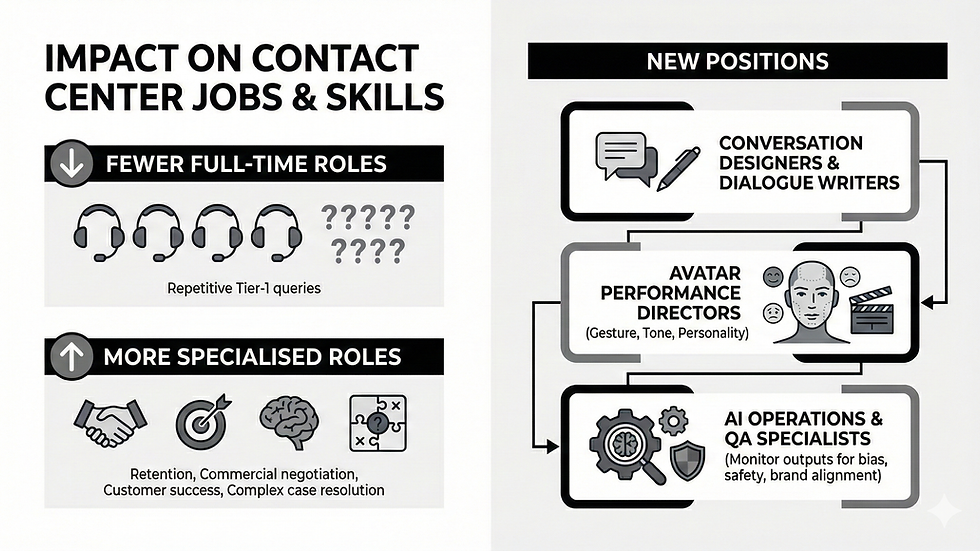
AI is already reshaping contact center roles but in uneven ways.
Some companies use automation to reduce headcount. Others, like Verizon, use it to augment large human teams and shift their focus from call handling to consultative selling.
We can expect:
Fewer full-time roles dedicated to repetitive Tier-1 queries.
More specialized roles in retention, commercial negotiation, customer success, and complex case resolution.
New positions like:
- Conversation designers and dialogue writers.
- Avatar performance directors (defining gesture, tone, and personality).
- AI operations and QA specialists, monitoring model outputs for bias, safety, and brand alignment.
This is not a simple “robots take all the jobs” story. It’s a shift from volume-based support work toward higher-skill, higher-context roles—provided organizations reskill thoughtfully instead of treating automation purely as a cost-cutting exercise.
Production Reality Behind Service Avatars

When brands partner with a studio like Mimic Productions to build virtual service representatives, the pipeline looks very similar to high-end character production:
Concept & character design: Defining the persona, demographic cues, wardrobe, and tone that align with the brand.
Scanning or modeling: Capturing a real performer using 3D body and facial scanning or building a bespoke character from scratch. Services like Mimic’s 3D body scanning and character creation pipelines are central here.
Rigging: Building facial and body rigs capable of real-time, expressive performance, often similar to those used in VFX or AAA games.
Performance capture: Recording facial nuances, body motion, and even subtle idles that make the avatar feel alive.
Real-time integration: Connecting the character to engines and conversational backends via real-time integration frameworks, ensuring low-latency lip-sync, eye contact, and gestures.
Deployment & orchestration: Embedding the avatar in web, mobile, kiosk, XR, or holographic environments, wired into live customer service systems.
The result is not a toy, but a production asset that must be robust, maintainable, and extensible—just like any other core part of your customer infrastructure.
Ethics, Consent, and Likeness
When a virtual agent is based on a real actor or employee, consent and rights management become non-negotiable. Studios that also work on film-grade digital doubles understand:
Rights to use a likeness must be explicit, time-bound, and purpose-bound.
Re-use of scans and rigs across contexts must be contractually defined.
“Deepfake-style” misuse is prevented by workflow, not just by policy.
The same ethical discipline used in entertainment digital humans needs to be applied to service avatars, especially as they become more lifelike and persistent across channels.
Comparison Table: Digital Humans vs Human Agents
Dimension | Digital Human / AI Avatar | Human Customer Service Agent |
Availability | 24/7, unlimited concurrency | Limited by shifts, burnout, staffing |
Speed on simple tasks | Very high; instant responses | Gated by queue and handle time |
Handling complex, novel issues | Limited, improves with training & oversight | Strong, especially with experience |
Empathy & emotional nuance | Simulated; improving but still constrained | Genuine, adaptable, culturally nuanced |
Consistency of messaging | Perfectly consistent when well-governed | Variable across agents and shifts |
Training & updates | Centralised, instant across all instances | Continuous training, coaching, QA required |
Cost per additional interaction | Very low marginal cost once system is deployed | Directly tied to labour cost |
Brand embodiment | Highly controllable visual and vocal identity | Less controllable; depends on hiring and training |
Trust & transparency | Depends on disclosure and experience design | Inherently higher trust for complex issues |
Job impact | Automates routine tasks | Shifts roles toward complex and high-value work |
Applications Across Industries

Digital human agents are already being tested or deployed in various sectors:
Retail & e-commerce: Guided product discovery, size and fit consultation, post-purchase support, and loyalty programs.
Banking & financial services: Explaining products, assisting with onboarding, basic account queries, and triaging fraud alerts while humans handle sensitive cases.
Telecom & utilities: High-volume billing questions, outage information, plan recommendations, and troubleshooting scripts.
Healthcare & pharma (within regulatory bounds): Non-diagnostic patient education, appointment management, and pre- and post-visit instructions.
Travel and hospitality: Booking assistance, itinerary changes, airport and hotel wayfinding, and loyalty program management. Case studies show virtual agents already active for airlines and travel brands.
For brands working with Mimic Productions, these use cases align with existing capabilities in AI avatars, conversational interfaces, and high-end 3D character services. This allows the same character to appear on a website, inside an app, on a kiosk, or as a hologram at an event.
Strategic internal links (use once each, as agreed):
To explore how Mimic builds production-ready AI-driven characters, see the AI Avatars service page at mimicproductions.com/ai-avatars.
For orchestration of dialogue, intent handling, and backend integration, the Conversational AI offering at mimicproductions.com/conversationalai covers the intelligence layer behind these experiences.
The underlying character creation craft—from sculpting to surfacing to animation—is detailed in mimicproductions.com/3d-character-services.
For projects based on real people, Mimic’s 3D body scanning capabilities (mimicproductions.com/3d-body-scanning) enable accurate digital doubles that can become persistent service personas.
When those characters need to appear in interactive, real-time contexts (web, apps, XR, live experiences), mimicproductions.com/realtime-integration addresses the deployment and engine side.
Benefits
1. For Organizations
Scalable service without linear headcount growth.
Reduced wait times and fewer abandoned calls or chats.
Consistent policy adherence and easier compliance management.
Richer data on customer journeys, pain points, and sentiment.
Cross-channel continuity, with the same persona present on web, app, kiosk, or XR.
2. For Customers
Instant responses for simple questions.
24/7 availability across time zones.
A more engaging interface than text-only chatbots.
Clear escalation paths when they need a human being.
3. For Human Agents
Less time spent on repetitive tasks.
More focus on complex, higher-value interactions.
AI tools that prep, summarize, and assist, reducing cognitive load and after-call work.
Challenges and Risks

1. Customer Trust and Transparency
If customers feel tricked—believing they’re speaking to a human when they’re not—trust erodes quickly. Surveys show many people will switch providers if AI usage in service is hidden or obstructs access to live support.
Best practice: Be explicit that the agent is virtual, show an easy path to a human, and log when handoffs happen.
2. Quality, Bias, and Hallucinations
Large language models can still generate incorrect or misleading answers. Enterprises need:
Guardrails on what the system can say.
Grounding in approved knowledge bases.
Human review for sensitive categories.
Monitoring and continuous tuning.
3. Production Complexity
Photoreal digital humans aren’t “just another UI”:
They require real character pipelines: modeling, rigging, mocap, animation, and rendering.
They must run efficiently in real time, on a wide range of devices and network conditions.
They need ongoing content updates: new scripts, gestures, and behaviors as products and policies change.
Studios with film and game experience are better positioned to handle this than basic chatbot vendors.
4. Ethical Considerations & Job Displacement
Clear consent around likeness, performance, and data is essential.
There is a real risk of using AI purely to cut staff without offering retraining or new opportunities. This can trigger reputational and regulatory pushback.
Hybrid models, with reskilling and transparent communication, are both more sustainable and more socially defensible.
Future Outlook: 5–10 Years Ahead
Based on current trajectories in AI tooling, avatar technology, and customer sentiment, a realistic forecast looks like this:
journeys. You’ll be greeted by a branded virtual host who can recognize you, speak your language, and handle a wide range of routine tasks.
60–80% of interactions in some verticals may be automated, especially low-risk, repetitive tasks. The rest will escalate to humans by design, not by failure.
Human agents will become more specialized, working alongside AI co-pilots, focusing on complex problem-solving, high-emotion cases, and relationship management.
Quality will diverge sharply between shallow and cinematic implementations. Brands that invest in properly produced digital humans—grounded in strong character design, performance capture, and real-time engineering—will feel radically different from those using generic, uncanny templates.
Most importantly: digital humans in support will become normal. The competitive edge will come from how well they are integrated, governed, and blended with human teams—not from whether a brand uses them at all.
FAQs
1. Will digital humans completely replace customer service agents?
No. They will automate a significant portion of repetitive, low-risk tasks, but complex, emotional, and high-stakes interactions will still require humans. The winning model is hybrid, not fully automated.
2. How are digital humans different from standard chatbots?
Chatbots are usually text-first and often invisible. Digital humans add a visual, animated persona, synchronized speech and facial performance, and richer non-verbal cues—built using 3D character modeling, rigging, and motion capture.
3. Where do AI avatars for customer service make the most sense today?
They’re ideal at the front door of support: greeting users, answering common questions, collecting information, and routing queries. They also work well for onboarding, guided walkthroughs, and tailored product explanations.
4. How do we avoid creeping customers out?
Be honest about the system being virtual. Give users clear control (easy access to a human), design the avatar with appropriate realism for the context, and ensure its behavior is calm, respectful, and consistent.
5. What’s required to build a high-quality virtual agent?
You need a combination of character craft (modeling, rigging, animation), performance capture, conversational AI, and real-time deployment expertise. That’s why many brands partner with specialized studios rather than treating avatars as a pure IT project.
6. Is virtual customer support secure and compliant?
It can be - as long as you apply the same standards you would for human staff: access controls, logging, data minimization, and policy-aligned training data. For regulated industries, human oversight and auditability are critical.
7. How long does it take to deploy a production-ready digital human?
Timelines vary by complexity, but realistic projects involve weeks to months of character creation, integration, testing, and iteration—especially when tying into multiple backend systems and languages.
Conclusion
Digital humans will not erase human agents from customer service. They will, however, radically change the shape of the work:
Front-line, repetitive contact becomes the domain of virtual agents and conversational AI.
Human teams focus on the edge cases: complex, emotional, and high-value interactions.
Customers benefit most when they can move seamlessly between the two—starting with speed and ending with empathy.
For organizations, the strategic question is no longer “Will AI replace our agents?” but “Which parts of our service journey should be human, which should be virtual, and how do we design the handoff so it feels effortless?”
Studios like Mimic Productions exist precisely at that intersection of film-grade digital humans and real-world service pipelines. They turn automation from a cost-cutting exercise into a carefully staged, human-centric experience.
Contact us. For further information and queries, please contact the Press Department at Mimic Productions: info@mimicproductions.com


Comments