.png)
How Markerless Motion Capture Works
Updated: Aug 27

What actually happens when you remove the suit, the markers, and the prep time from a motion capture session?
Markerless Mocap promises a cleaner, faster route from performance to digital character. No reflective markers. No calibration routine around a performer’s body. No waiting for a suited actor before previs can begin. In the right context, that promise is real. Modern markerless systems use multi camera video, computer vision, machine learning, and human motion solving to infer a performer’s movement and turn it into usable 3D motion data. Vicon’s current approach combines purpose built hardware with Shōgun Markerless and Shōgun Post so teams can capture unmarked performers, stream motion, review takes instantly, and retarget performances into engines and animation tools already used across film, games, and virtual production.
But the production reality is more disciplined than the headline. Markerless capture is not a universal replacement for every optical stage, every prop heavy performance, or every hero shot. It is strongest when speed, iteration, accessibility, and early creative exploration matter most. It becomes more fragile when the brief demands absolute precision under severe occlusion, dense physical interaction, or complex contact with costumes, props, and other performers. Independent research continues to show that markerless systems are improving quickly, while still facing challenges around joint center accuracy, environmental robustness, and difficult multi person scenes.
For studios building believable digital characters, the real question is not whether markerless is the future. The real question is where it belongs in the pipeline. In practice, the strongest answer is often hybrid. Markerless capture can accelerate blocking, previs, rapid prototyping, and creative development, while more controlled optical workflows still matter when a sequence cannot tolerate ambiguity. That production logic sits naturally alongside services like motion capture production, body and facial rigging, real time integration, 3D animation, and photo realistic 3D character models, which are the most contextually relevant service pages from the URL set you provided.
Table of Contents
What Markerless Mocap Actually Is

Markerless Mocap is motion capture performed without reflective body markers, sensor suits, or instrumented performers. Instead, a set of calibrated cameras records the performer, and software identifies body keypoints, estimates pose, reconstructs motion in 3D, and solves that motion onto a digital skeleton. Vicon describes its system as using advanced computer vision, machine learning models, and human motion solving algorithms trained on large motion capture datasets to recognize joints, limb positions, and movement patterns.
That definition matters because it separates markerless capture from the myth surrounding it. It is not raw video magically becoming final animation. It is still a pipeline. Camera placement still matters. Calibration still matters. Skeleton solving still matters. Retargeting still matters. Review still matters. Cleanup still matters. The difference is that the performer no longer needs to wear the traditional optical tracking setup, which changes the speed and psychology of a session as much as the technology itself. Vicon positions this shift around faster iteration and earlier creative decision making, particularly in previs, prototyping, games, and virtual production.
In a studio environment, that can be transformative. Directors can test staging sooner. Character teams can explore body language before committing to a final rig pass. Animation supervisors can validate whether a performance reads in silhouette before spending time on detailed cleanup. For digital human work, the value is not just capture speed. It is pipeline compression.
How Vicon’s Markerless System Works

Vicon’s markerless offering is built around a dedicated camera called Vanguard and software inside the Shōgun ecosystem, specifically Shōgun Markerless and Shōgun Post. According to Vicon and Oxford Metrics, the system was introduced in 2025 as a markerless motion tracking solution designed for rapid creative iteration, using machine learning, computer vision, and Vicon’s established solving technology.
At a practical level, the workflow looks like this:
Multiple calibrated cameras observe the performer from several angles
The software detects the body across views and estimates pose over time
Motion solving reconstructs a coherent 3D performance from those observations
The result can be streamed, recorded, reviewed instantly, and retargeted to a character skeleton
Markered props can be used alongside unmarkered performers in the same broader Shōgun workflow
Vicon also emphasizes integration rather than isolation. Its markerless system sits within the same production environment as optical capture, with workflows into Unreal Engine, Autodesk MotionBuilder, and character retargeting inside Shōgun. That matters because production teams do not buy motion capture in the abstract. They buy continuity across previs, techvis, blocking, live visualization, post, and final animation.
This is where the system becomes interesting for high end character work. A performer can enter the volume in everyday clothing, capture a rough or intermediate body performance, and see that data move quickly into a digital asset. For teams already building assets through photo realistic 3D character models and preparing deformation systems through body and facial rigging, the speed gain is not only on set. It affects the entire handoff between performance, rig, animation, and review.
Why the Technology Is Attractive to Production Teams
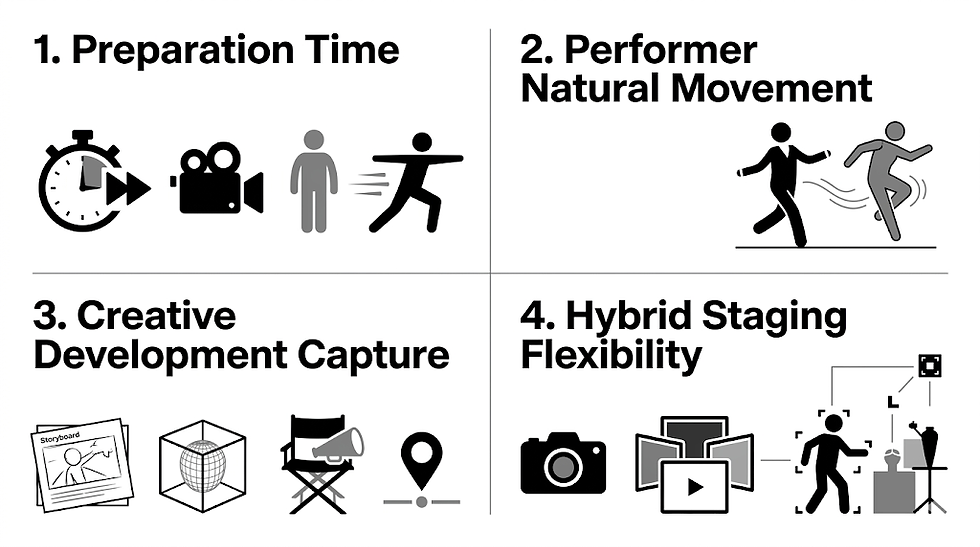
The most obvious advantage is preparation time. Vicon highlights the ability to capture performers without suits or markers, which reduces setup friction and lets teams move more quickly from idea to motion test. Its own product language focuses on instant visualization, consistent streaming and recording, and quick playback inside the Shōgun ecosystem.
That has several downstream effects.
First, performers often move more naturally when they are not instrumented. Even when experienced talent is comfortable in a mocap suit, removing the gear changes the feeling of rehearsal. It reduces the sense that the actor is entering a technical procedure and restores some of the ease of normal performance.
Second, creative teams can capture earlier in development. Vicon explicitly markets markerless toward ideation, previs, and rapid prototyping. In production terms, that means more movement tests before lock, more editorial exploration, and more room for directors, animators, and engine teams to solve problems before the expensive stage of final animation polish.
Third, hybrid staging becomes easier. Vicon states that unmarkered performers and markered props can be captured within the Shōgun workflow, which is especially relevant in virtual production and interactive engine driven pipelines. When paired with real time integration, that makes markerless capture more than a capture choice. It becomes a visualization tool.
Fourth, access widens. Not every creative test deserves a full traditional stage booking. Markerless lowers the barrier for movement studies, gameplay prototyping, character blocking, and internal pitch material. That is part of the reason Vicon frames the technology as a way to empower smarter decisions early on.
Where the Problems Begin
This is where the conversation needs discipline.
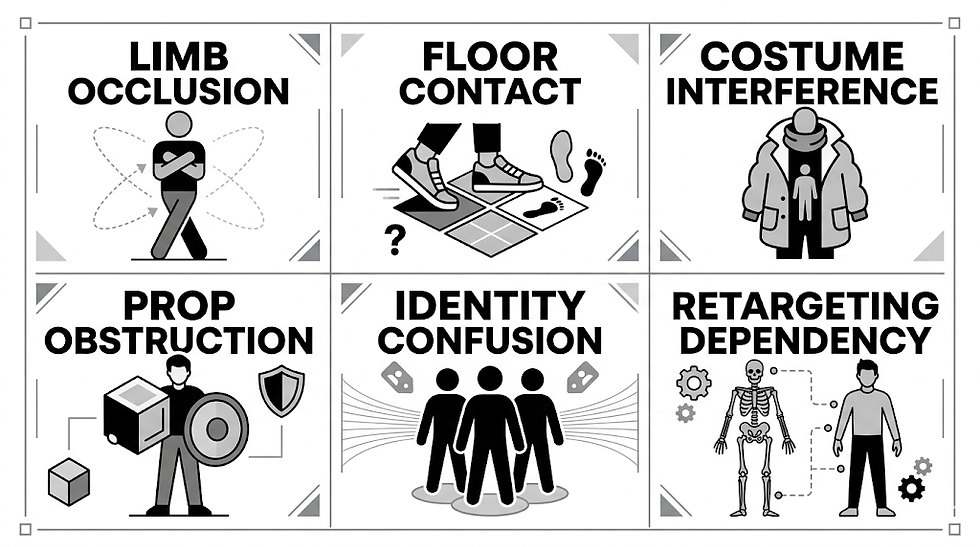
Markerless systems do not observe the body in the same way marker based optical systems do. They infer motion from image data. That creates familiar weaknesses. Occlusion remains a major issue in the broader research literature, especially when limbs cross, performers interact closely, garments obscure landmarks, or body parts disappear from multiple camera views. Multi person complexity and realistic scene variation still cause substantial degradation in current state of the art benchmarks.
Accuracy is also task dependent. Recent reviews in sports and biomechanics report variable error ranges and sensitivity to environmental factors, camera setup, and movement type. That does not make markerless unusable. It means the data should be judged against the demands of the specific production task. A broad body performance for previs has a very different tolerance than a final hero animation driving a close digital double shot.
There are also production specific pressure points that are not always clear in promotional copy:
Fast limb crossings can destabilize pose estimates
Floor contact may look plausible without being physically trustworthy
Heavy costumes can hide anatomy the solver expects to see
Prop interaction can break clean body visibility
Similar looking performers in shared space can confuse identity continuity
Retargeting still depends on skeleton quality and character setup
This is why markerless should be understood as a capture method, not a guarantee of final animation quality. Good motion data still depends on camera design, volume planning, solver behavior, character proportions, rig architecture, and animation supervision. A weak character setup will not be saved by a faster capture stage. In practice, strong results still depend on careful 3D animation and robust body and facial rigging.
Markerless Versus Marker Based Capture
Category | Markerless capture | Marker based optical capture |
Performer prep | Minimal prep, no suit or reflective markers | Requires suit fitting, marker placement, setup discipline |
Speed to first take | Faster for ideation, previs, rapid tests | Slower to begin, more controlled once live |
Best use case | Blocking, previs, prototyping, early iteration | High precision capture, complex hero performance |
Occlusion behavior | Quality can drop when visibility collapses | Occlusion still an issue, but anchored to tracked markers |
Prop heavy work | Possible, but body visibility becomes critical | Stronger for controlled prop workflows |
Pipeline flexibility | Excellent for quick turn rounds and visualization | Excellent for established final production pipelines |
Production reality | Best when speed matters more than certainty | Best when certainty matters more than speed |
Why Hybrid Pipelines Are Becoming the Practical Standard

The most credible production model today is hybrid.
Use markerless when the team needs speed, flexibility, and immediate visual feedback. Use traditional optical capture when the sequence demands highly controlled performance data, dense interaction, or a stronger guarantee under difficult conditions. Move between both inside a shared downstream pipeline for solving, retargeting, animation cleanup, and engine output. That is effectively the logic Vicon is building around by integrating markerless with optical systems and Shōgun based post workflows.
For a digital human studio, that hybrid logic is especially useful:
Markerless can support early body language exploration before final asset lock
Optical capture can support the most sensitive hero moments
Real time preview can inform shot design and virtual camera decisions
Animation and rigging teams can evaluate what needs cleanup before commit
Rendering teams can plan whether the performance is destined for real time output or offline final pixel work
That is why markerless should be discussed alongside the whole character pipeline. Capture alone does not produce a convincing human performance on screen. It must connect to modeling, rigging, deformation, lookdev, engine integration, and final output. When that connection is missing, even good capture becomes expensive noise. When it is present, the system becomes part of a coherent production machine that can extend into 3D rendering services or real time outputs for immersive work.
Applications

Markerless Mocap is already useful in a range of production contexts, particularly where time, iteration, and accessibility matter.
Previsualization: Directors and animation teams can test action, pacing, and silhouette quickly before committing to heavier production stages. Vicon explicitly positions markerless for ideation and previs.
Game development: Vicon lists game studios among its core users and supports streaming into game engines. For gameplay prototyping and fast character iteration, markerless is a natural fit.
Virtual production: When movement needs to be visualized in engine during creative development, a markerless setup can compress the gap between rehearsal and digital output, especially when combined with real time integration.
Digital human development: Studios building believable characters can use markerless body capture to explore motion style before moving into more refined animation and rendering stages.
XR and immersive experiences: Because creative iteration is central to immersive design, markerless capture can support faster experimentation in XR experiences.
Benefits

Faster access to motion data without performer instrumentation
Easier creative experimentation during early production
More natural performer experience in many scenarios
Better fit for previs, prototyping, and internal development loops
Stronger pipeline continuity when integrated with optical capture, retargeting, and engine streaming
Future Outlook
The future of Markerless Mocap is not a simple takeover narrative. It is a convergence story.
Research continues to improve robustness, reliability, and real world applicability, but difficult multi person scenes, severe occlusions, and complex interactions still expose the limits of current models. At the same time, vendors like Vicon are no longer treating markerless as an isolated experiment. They are embedding it into mature production ecosystems built around capture, post, retargeting, and engine output.
That suggests the real future is not markerless instead of optical. It is markerless alongside optical, facial systems, scanning, rigging, and rendering in a more modular pipeline. As digital characters become more common across cinema, games, immersive installations, and AI driven avatars, the winning studios will be the ones that know where each capture method belongs and how to bridge them cleanly into final performance.
FAQs
Is Markerless Mocap accurate enough for final animation?
Sometimes, but not always. It depends on the shot, the movement, the environment, and the acceptable margin of error. For previs and rapid iteration, it is already highly valuable. For the most demanding hero work, traditional optical capture may still be the safer choice.
How does Vicon’s markerless system differ from generic video pose estimation?
Vicon combines dedicated capture hardware, calibrated multi camera workflows, machine learning based body tracking, human motion solving, retargeting, playback, and integration with existing Shōgun and engine pipelines. It is designed as a production system, not just a pose estimation demo.
Does markerless mean no cleanup?
No. Capture quality, retargeting quality, and final animation quality are still separate things. Cleanup, rig compatibility, and animation supervision remain important.
Can markerless work with props?
Yes, but production conditions matter. Vicon states that its broader Shōgun workflow can handle unmarkered performers and markered props together. The challenge is that props can also create occlusion and body visibility issues depending on the action.
Is markerless replacing marker based optical capture?
Not completely. The strongest current model is hybrid. Markerless is excellent for speed and accessibility. Marker based systems still retain advantages when a production needs maximum control and reliability in difficult capture conditions.
Conclusion
Markerless Mocap is no longer a speculative idea. It is a practical production tool. Vicon’s system shows how far the category has moved by combining machine learning based body tracking, dedicated hardware, real time playback, retargeting, and integration with established animation and engine workflows.
The promise is real. Faster access to movement. More natural performer sessions. Better previs. Smarter iteration. Lower friction between idea and result.
The problems are real too. Occlusion. variability under complex conditions. task dependent accuracy. the persistent need for cleanup, rig quality, and production judgment.
The production reality sits between those two truths. Markerless works best when it is treated not as a replacement slogan, but as one intelligent part of a larger character pipeline. For studios building high credibility digital humans, that is the mature position. Capture the right performance with the right tool, then let the rest of the pipeline do its work.
For inquiries, please contact: Press Department, Mimic Productions info@mimicproductions.com


Comments