.png)
Virtual Influencers for Fashion: Lookbooks, Runways, and Campaigns
Updated: Aug 27

Fashion has always worked with constructed images. Mannequins, lookbooks, backstage polaroids, runway films, and now fully digital muses. What is new is not the idea of an idealised model, but the level of control, continuity, and realism that virtual characters now bring to brand storytelling. Virtual Influencers for Fashion sit exactly at that intersection, where character technology meets creative direction, and where a collection can live across social feeds, runways, games, and retail all at once.
This article looks at how digital fashion personalities are designed and produced when you treat them as cinematic characters rather than quick social experiments. We will move through the full pipeline, from concept and scanning to rigging, cloth simulation, real time engines, and campaign orchestration. Along the way, we will look at how these virtual muses behave in lookbooks, runway shows, and multi channel campaigns, and what that means for creative teams, agencies, and fashion houses.
Table of Contents
Why Virtual Influencers for Fashion emerged now

The idea of a virtual fashion muse is not an accident of social media; it is the result of three converging forces.
First, engagement economics. Studies show that synthetic influencers often deliver up to three times the engagement of human creators, with campaign averages around five point nine percent versus one point nine percent for comparable human campaigns. Brands are understandably interested in any format that performs that efficiently at scale.
Second, control and consistency. When a character is fully digital, every appearance, statement, and garment pairing can be aligned with brand codes. There are no last minute cancellations, no unapproved posts, no reputational surprises. Recent surveys suggest that around fifty eight percent of social media users already follow at least one virtual persona, and roughly a third have bought a product promoted by one. This is no longer a fringe experiment.
Third, pipeline maturity. The same production technology used for cinematic digital doubles and game characters now flows into fashion work. Photoreal body scanning, physically based shading, performance capture, and real time rendering mean a digital model can carry a collection with believable skin, fabric, and movement. At the lighter end of the spectrum, brands can now generate an AI influencer to prototype a persona's face, voice, and vibe in hours rather than weeks. For studios like Mimic, which already build film grade digital humans and characters, carrying those capabilities into fashion is a natural extension.
At the same time, the concerns are real. Academic work still finds that human influencers outperform synthetic ones on perceived authenticity and emotional warmth, even when the digital character is beautifully executed. The craft is not just about realism; it is about narrative, ethics, and clear communication that this is a constructed persona.
From sketchbook to screen, how a digital fashion muse is built

Treat a virtual fashion figure as a serious character, and the process starts long before the first rendered image.
Character definition
A production ready fashion muse needs a complete creative bible.
Cultural context, age, personality, values
Role in the brand world, from insider atelier presence to globetrotting storyteller
Visual language, hair, body type, posture, gaze, signature poses
Wardrobe logic, how they wear tailoring, streetwear, couture, athletic gear
This is the foundation that informs modeling, texturing, and animation decisions. It ensures the character feels coherent when they move from an editorial film to a store screen to a game engine.
Scanning and modeling
There are two main approaches.
For a realistic figure inspired by a real person: You may start with a full body scan session or photogrammetry, capturing skin detail, silhouette, and natural posture. That scan becomes the base for a clean production mesh, retopologised for deformation and cloth interaction. Facial detail can be captured in a dedicated session for expression scanning.
For a stylised virtual icon: You can work directly from concept art, building a character with proportions closer to animation or illustration. Even then, you want a robust model topology, clean UVs, and enough anatomical grounding that garments move convincingly.
In both cases, the result is a high quality asset that can slot into wider character creation services rather than a one off experiment.
Rigging and facial systems
The skeleton and facial setup are what turn a static sculpt into a viable fashion model.
Body rig with stable deformations at shoulders, hips, knees, and ankles, tuned for walking cycles, poses, and dance
Facial rig capable of subtle expression, not just broad smiles and frowns, so that beauty closeups can carry emotional nuance
Deformation systems for feet and hands that hold up in shoe and accessory focus frames
Studios that already deliver complex body and facial rigs for film and game work bring that same discipline into virtual fashion influencers, knowing that nothing exposes a weak rig faster than a close crop on a jawline during a beauty shot.
Hair, cloth, and material setup
Wardrobe sells the collection; hair and cloth sell the reality. Dedicated hair and garment simulation teams tune strands, curls, braids, and fabrics for both stills and motion, often building on services like hair and clothing development.
Shaders use physically based properties for silk, leather, technical nylon, and knitwear so that fabrics behave correctly across lighting setups.
Performance capture
When the character needs to walk, dance, or perform, motion capture brings human intent into the digital frame. A performer moves in a capture volume; a technical team cleans, retargets, and edits the data onto the digital rig. Facial capture can be recorded simultaneously for closeups. This is where experience from motion capture for film and games pays off, especially for runway sequences and campaign films that need confident, grounded motion.
Lookbooks with synthetic models, production workflows that actually scale

Static lookbooks used to be simple. A studio, a model, a day of shooting, a retouching phase. Virtual models change the economics but also the creative canvas.
Single asset, many shoots
Once a digital muse and a core library of garments exist, teams can shoot an entire season in different locations without booking a single flight. Rain in Tokyo, sun in Marrakesh, studio light in Berlin; each is a lighting setup, not a logistical puzzle.
One collection can be presented as an interactive lookbook on ecommerce, a cinematic film, and a set of social stories with consistent styling.
Color corrections and last minute design tweaks can be made globally, not image by image.
Localised content for different markets can be generated from the same base renders, adjusting backgrounds, accessories, or narrative elements.
Digital fashion and fit
Modern digital clothing relies on pattern accurate garments simulated on the rigged body. Tools from the digital fashion space make it possible to import real pattern data, test drape and fit, and visualise layering before anything is sewn. For brands exploring virtual garments alongside physical ones, a pipeline similar to Mimic’s digital fashion work allows the same asset to live in lookbooks, games, and metaverse environments.
Editorial storytelling
The most effective synthetic lookbooks feel like editorials, not catalogues. They use crafted lighting, narrative beats, and environmental design. A camera path might track the model as she moves through a digital recreation of Chantilly stables, then into a monochrome studio. The character’s posture and eye line shift, and the garments tell a story, not just a SKU list.
Runways reimagined, from volumetric stages to game engines

Runway shows are no longer limited to a physical stage with a limited audience. Virtual muses have opened several parallel formats.
Fully digital shows
Brands like Balmain pioneered campaigns with a cast of purely digital supermodels, each wearing digital recreations of their collection. Here the runway is not a physical space at all; it is a narrative film rendered from a game engine or offline renderer, with complete freedom over camera moves, gravity, and physics.
Hybrid shows
A physical show can feature live models alongside large scale screens or holographic projections of a virtual muse, or even place the digital character in pre recorded segments leading into each section. This allows a synthetic ambassador to introduce the narrative or appear in locations the show can only reference through film.
Interactive and game based presentations
Engines like Unreal power branded experiences that feel like games instead of linear films. Players move through an environment, meet the virtual fashion influencer, and unlock looks. Louis Vuitton’s work with game characters for collections hinted at this direction; we now see extended experiences where the collection becomes wearable content in a virtual world.
In all of these, a robust real time integration pipeline, like the one described for Mimic’s real time integration, ensures that the character behaves consistently whether they are pre rendered for a hero film or driven live on stage from a performance capture feed.
Campaign ecosystems, one character across many realities

The most interesting virtual fashion muses are not one off stunts. They are long running characters who move across media.
Social presence
Virtual personalities such as Lil Miquela built audiences in the millions by behaving like real people online, posting outfits, activism, and music releases while collaborating with labels like Prada, Calvin Klein, and others. For fashion houses, a similar character can translate the collection into daily life, not just campaign shots.
Owned virtual ambassadors
Many brands now prefer to own their synthetic ambassador outright. They work with a studio to design, build, and maintain a character that personifies the house. That character then appears in fragrance campaigns, pre collection teasers, metaverse partnerships, and even in store screens. This avoids the fragility of rented influence and brings the control of a mascot with the nuance of a living model.
Conversational and interactive formats
With advances in embodied AI, a virtual muse can answer questions, host live streams, or guide users through a collection in real time. When combined with AI avatar pipelines, the same face and voice can power a fashion advisor in retail, a runway commentator on social, and a concierge inside an immersive brand world.
Comparison table
The reality is nuanced. Human talent and synthetic models are not direct replacements; they are different tools with overlapping strengths.
Aspect | Human influencer | Virtual fashion muse |
Creative control | Subject has personal voice and choices | Brand and studio define every appearance and statement |
Speed and flexibility | Travel, scheduling, and availability constraints | Can appear anywhere at any time once built |
Cost profile over time | Per shoot or per campaign fees, travel and production costs | Higher initial build cost, then efficient reuse across many campaigns |
Risk and reputation | Subject to personal life events and social media history | Behaviour defined in script and controlled environments |
Perceived authenticity | Strong sense of lived experience, human fallibility | Can feel distant if storytelling and disclosure are weak |
Data and experimentation | Limited to what a person is comfortable doing | Wardrobe and narrative arcs can be A B tested at scale |
Applications across luxury, sportswear, beauty, and retail
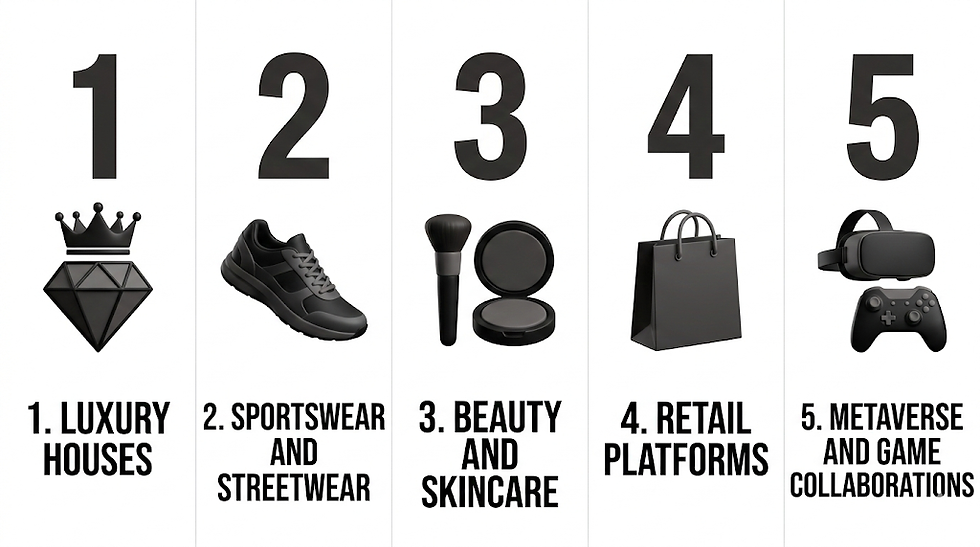
Virtual Influencers for Fashion are most compelling when they are tightly aligned with a clear use case rather than treated as novelties.
Luxury houses
High fashion brands can use a digital muse to move between couture shows, fragrance launches, and capsule drops, tying everything together through a single personality. The same character might attend a metaverse fashion week, appear in an immersive installation, and front a traditional print campaign.
Sportswear and streetwear
Athletic labels can cast virtual athletes that embody movement and performance. Because synthetic bodies are not bound by gravity or risk of injury, motion can be pushed further to show footwear and apparel in extreme environments, while still grounded in real performance capture.
Beauty and skincare
Beauty brands already rely heavily on closeup imaging. Digital humans with finely tuned skin shaders and facial rigs can demonstrate makeup and skincare in controlled lighting, showing shade range and finish with a level of repeatability that is difficult in physical shoots. The key is to be upfront that the face is digital, and to use physically accurate shading rather than impossible perfection.
Retail platforms
Ecommerce platforms can deploy a small roster of digital models that reflect diverse body types and cultural backgrounds. Customers can see garments on a figure closer to their own proportions, and those same characters can reappear in personalised recommendations and seasonal stories.
Metaverse and game collaborations
As game worlds and virtual spaces continue to host fashion events, virtual muses become native citizens of those environments. They can attend virtual concerts, host quests, and wear both digital only garments and pieces that also exist in the physical collection.
Benefits for creative direction, production, and sustainability
When executed with care, this approach offers concrete advantages beyond novelty.
Creative continuity
A single virtual muse can carry a multi year narrative. Their personal growth mirrors the evolution of the brand, and audiences can follow arcs rather than isolated campaigns. This continuity is difficult to achieve with rotating human talent.
Production efficiency
After the initial build, a digital character can appear in many different shoots without new casting, travel, or location costs. Virtual influencer campaigns can be up to fifty percent more cost effective than human campaigns when run at scale, while still delivering higher engagement. For brands operating across many regions, this compounds quickly.
Sustainability
Virtual shoots reduce the need for air travel, physical samples, and large scale set construction. Digital only garments allow experimentation without material waste. While render farms still consume energy, careful optimisation and the use of real time engines can lower the footprint compared to multiple international shoots.
Brand safety
Because behaviour is scripted and assets are centrally managed, there is minimal risk of off brand statements or scandals. This stability is one of the main reasons marketers predict that a significant share of influencer budgets will shift to synthetic talent in coming years.
In short, with Virtual Influencers for Fashion, creative direction can explore bolder narratives while production becomes more predictable.
Future outlook, embodied AI and live performing avatars

Looking ahead, the line between static campaign asset and live performer will blur.
We will see:
Embodied AI systems that allow a virtual muse to respond in real time to audience questions during live streams, within clear safety and brand guardrails.
Real time performance capture driving characters in virtual production stages, enabling live runway shows with digital models reacting to music and audience energy.
Connected wardrobes where a garment appears on a digital muse in a campaign, as a wearables item in a game, and as a trackable physical piece with a digital passport.
For studios operating within ecosystems like the Mimicverse, these characters will not live in isolation. They will share rigs, shaders, and performance data with digital humans used in film, games, XR, and customer experience, creating a consistent cast of virtual performers that brands can work with across many contexts.
FAQs
Do virtual fashion muses always need to look realistic?
No. Some of the most successful virtual personalities are clearly stylised. The key is consistency. A stylised character can work as long as their world, lighting, and wardrobe are designed around that aesthetic.
How long does it take to create a production ready virtual fashion influencer?
Timelines vary with complexity, but a serious build typically spans several weeks to a few months. You need time for concept, modeling, texturing, rigging, hair and cloth systems, performance tests, and the first campaign.
Can a brand start small?
Yes. Many brands begin with one tightly scoped project, such as a digital lookbook or a single campaign film, then extend the character into social and interactive work once the response is clear.
How do you keep followers from feeling misled?
Be candid from the start. State that the character is virtual, disclose any sponsored partnerships, and let the persona develop a voice that acknowledges its digital nature. Audiences are comfortable with fiction; they react badly only when they feel something is hidden.
Will these characters replace human models?
They will sit alongside them. Human talent still brings lived experience, improvisation, and a sense of vulnerability that is hard to script. Virtual talent offers control, continuity, and reach. The strongest brand ecosystems will use both.
Conclusion
Virtual Influencers for Fashion are not shortcuts; they are long term creative commitments. When treated as serious characters built on rigorous scanning, rigging, performance capture, and shading, they can hold their own in lookbooks, on virtual runways, and across intricate campaign ecosystems.
For fashion houses, agencies, and platforms, the task now is to decide where such a character genuinely serves the story. When a virtual muse extends the brand world, deepens narrative, and respects the audience’s intelligence, they become more than a trend. They become a new kind of collaborator, one that can move fluidly between physical shows, digital platforms, and the emerging spaces in between.
For inquiries, please contact: Press Department, Mimic Productions info@mimicproductions.com

Comments