.png)
Performance Capture Explained. How Human Movement Becomes Animation
Updated: Aug 27
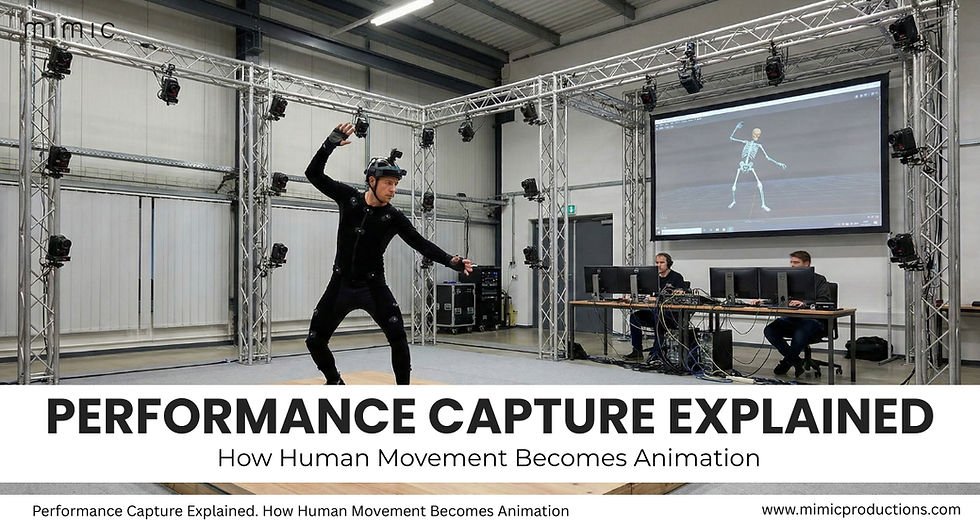
In modern production, the most convincing digital characters do not start on a workstation. They start on a stage, with an actor in a suit, surrounded by cameras, microphones, and careful supervision. What looks like a technical ritual is in fact a very direct goal translating human intent into digital motion with as little loss as possible. This is where performance capture comes in.
Rather than treating body, face, and voice as separate ingredients, this approach records the entire performance as one unified event. The result is a continuous line from rehearsal to edit, where a character’s physicality, emotional beats, and timing all originate from a real person and are then carried forward through rigging, solving, and animation polish. For studios like Mimic Productions, that continuity is what allows a digital human to feel genuinely present rather than simply well animated.
This article walks through how a live performance becomes animation, where the creative and technical responsibilities sit, and what distinguishes full performance capture from traditional body only motion capture or hand keyed animation.
Table of Contents
What we mean by performance led capture

In classic motion capture, the focus is primarily on recording body movement for specific actions combat, locomotion, stunts and then editing or layering animation on top. Performance capture extends this idea. It treats the actor’s full expression body mechanics, facial nuance, eye direction, and voice as a single performance that needs to be preserved.
The camera layout, suit choice, facial system, and even the shape of the capture volume are all designed so that the actor can genuinely act rather than simply hit technical marks. At Mimic, a typical session in the motion capture studio is blocked and rehearsed like a live scene, with directors, stunt coordinators, and data supervisors working together so that both the drama and the data work.
From the actor’s point of view, the ideal experience is simple. They step into a stage that feels like a stripped back set. They are wired with microphones, suited, marked, and fitted with a head camera or facial markers. After a short calibration, they perform the scene repeatedly. Behind the scenes, every gesture is mapped to a digital skeleton, every brow movement is indexed against a facial rig, and every line of dialogue is synchronized to timecode.
The end to end pipeline from actor to character

Although each project has its own nuances, the pipeline from human movement to finished animation usually follows a clear sequence.
1. Concept, casting, and preparation
Everything starts with the character brief. Is this a photo realistic double of a known actor, a stylized creature, or a real time avatar that will live across the Mimicverse ecosystem. That decision informs body scanning, rig design, and the level of fidelity required for both body and facial capture.
If the character is based on a real person, the studio will often begin with detailed three dimensional body scanning to lock in proportions, costume volumes, and facial details. The output of that step flows into character modeling and the creation of a production ready digital double.
Casting is equally crucial. For a digital human or hero creature, there may be a separate scan model, face double, and stunt performer. The team decides whether to capture a single unified performer or blend performances across multiple talents, which has implications for retargeting and rig calibration.
2. Stage setup and calibration
On the day of capture, the stage becomes a controlled measuring instrument. Optical cameras or inertial sensors are positioned to cover a defined volume. Props are set. Lighting is adjusted so cameras can see reflective markers or active LEDs without contamination.
The actor is dressed in a capture suit with markers or embedded sensors, then fitted with a head mounted camera rig or facial markers, depending on the facial pipeline selected. A short series of calibration moves follows T pose or A pose, range of motion exercises, facial expressions, and line reads. These short clips give the technical team a reference of how the actor’s anatomy and face move through space.
On the data side, all devices are locked together with shared timecode. Body system, facial system, audio recorders, and any reference cameras need to agree on what frame one is. That synchronisation is what makes unified performance capture possible rather than four separate recordings that later need to be guessed into alignment.
If you look at the motion capture service page from Mimic Productions, you can see how much attention is paid to stage layout, camera density, and calibration process because clean data early on saves days of work later.
3. Recording body, face, hands, and voice
Once the stage is calibrated, the production feels very close to a film shoot. There is a director calling action, a script supervisor tracking takes, and a digital imaging technician equivalent watching the data stream in.
Body data is captured as the actor moves through the volume. Optical systems reconstruct marker positions into a three dimensional skeletal representation. Inertial suits capture orientation and acceleration from many small sensors on the body. Hands can be recorded with additional gloves, optical markers, or specialist systems.
For facial data, studios combine either head cameras or multi camera arrays with facial tracking software. The tools map the motion in those images to a set of facial controls blendshapes, bones, or a parametric face model similar to FACS. Voice capture uses production quality microphones often mounted directly on the actor.
The key difference to traditional approaches is that all of this is recorded with the intention of keeping the performance intact. The actor’s pause before a line, the shift of weight before a sprint, the subtle facial reaction after another character speaks these are not secondary details, they are the core of the data set.
4. Data clean up and solving
Raw capture looks nothing like a finished shot. Markers drop out when an arm occludes the view, sensors drift, head cameras pick up small jitters, and actors inevitably step near the edge of the volume. The first task after a shoot is therefore not animation but data forensics.
Technicians track missing markers, correct swaps when two markers are misidentified, and filter noisy channels. Solvers then reconstruct the most likely pose of the actor’s skeleton for every frame based on the visible data. For facial data, solvers map image sequences or marker sets into the facial rig’s control space.
This is where rigging quality becomes non negotiable. A robust body and facial rig, like those described in Mimic’s body and facial rigging service, must respond predictably to incoming data and also support animator friendly refinement. Bad rigs either crush the nuance from capture or make later polish unreasonably painful.
Once the data has been solved, it is retargeted onto the production character. The performer’s proportions rarely match the digital character one to one. Retargeting systems preserve intent foot plants, timing, arcs and adapt them to new proportions while maintaining physical believability.
5. Animation refinement and secondary effects
Even the best take does not go straight to final pixels. Animation teams review the performance on the character and adjust timing, arcs, and eye lines where needed. They might blend multiple takes, amplify specific beats, or remove unwanted ticks that read differently on a stylized character than on a human actor.
Fine detail often requires animator intervention especially around eyes, fingers, and cloth interaction. For a photo realistic production, this is also the stage where secondary motion joins the performance realistic hair simulation, cloth behavior, and subtle muscle dynamics. Mimic’s separate service for three dimensional hair and clothing can be tightly integrated here so that the physical performance and the simulated response feel like one continuous motion.
Once a shot is approved, it becomes part of a render pipeline or real time integration stack. For linear work, animation goes into a lighting and rendering setup, where shading, global illumination, and compositing complete the shot. For real time experiences, the retargeted motion drives a character in an engine, often using Mimic’s three dimensional animation and integration expertise to ensure performance holds up at interactive frame rates.
6. Real time preview versus offline passes
One of the practical advantages of modern full performance capture is true real time feedback. With a tuned pipeline, the director can watch an approximation of the final digital character on a monitor while the actor performs on stage. This is especially valuable for mixed reality and virtual production work where the actor’s spatial relation to virtual elements matters.
Real time preview does not replace offline processing. It guides creative decisions and lets teams adjust blocking, lenses, or timing on the day. High fidelity solving, facial refinement, and simulation still happen in offline passes, where the latency budget can be minutes instead of milliseconds.
Studios that can move gracefully between these worlds tend to get the best of both reacting quickly to actors in the moment while still honoring the meticulous demands of film grade digital human work.
Comparison table
Below is a compact view of how different approaches relate.
Approach | Focus | Strengths | Limitations |
Classic motion capture | Body mechanics and physical actions such as running, combat, and sports moves | Efficient for large libraries of actions; ideal for reusable move sets in games and crowd simulations | Facial expression and voice are usually handled separately, which can reduce emotional continuity |
Performance capture | Unified acting of body, face, voice, and timing for complete scenes | Highest emotional fidelity; best for story scenes, digital doubles, and believable virtual characters | Higher setup cost; more complex stage logistics; heavier data clean up and post production work |
Keyframe animation | Artist driven motion created by hand on a rig | Unlimited stylistic control; ideal for exaggerated or fantastical motion; no capture gear required | Time intensive for complex scenes; difficult to match subtle human nuance without very experienced animators |
For a deeper breakdown, Mimic Productions has an article that explores motion capture versus performance capture in detail, which is a useful companion to this overview.
Applications

Film and episodic storytelling
In narrative work, full performance acquisition shines when characters must carry emotional weight close up on the eyes, intimate dialogue scenes, or highly reactive ensembles. Digital doubles allow productions to push stunts, de aging, or complex camera work without compromising safety.
The process often combines multiple assets. A photo realistic character model built for a specific actor, a facial rig tuned to their unique expressions, and a capture plan designed to maintain continuity across pick ups and additional photography. When this is paired with high end visual effects, as in Mimic’s work on digital doubles for cinema, the line between live action and synthetic becomes very hard to see.
Games and interactive experiences
Games benefit from both sides of the process. Large libraries of movement for locomotion and combat, and high fidelity performances for cinematic moments. Modern engines can now stream these performances directly, allowing believable, reactive characters in real time. Mimic’s experience in games and interactive three dimensional industries places a strong emphasis on how these performances blend with player input.
A single actor performance may be decomposed into layers that drive locomotion, aim, facial responses, and contextual gestures which designers can then trigger dynamically.
Extended reality, installations, and live events
In XR installations, immersive experiences, and holographic shows, the ability to re use a captured performance across formats is invaluable. A single capture session can feed a head mounted display, a large scale projection, and a volumetric style hologram.
Because these experiences run in real time engines, the underlying data must be efficient as well as expressive. Mocap pipelines are therefore carefully profiled so that character rigs and animation clips remain performant on target hardware while retaining enough fidelity for close viewing.
AI driven avatars and conversational agents
As AI avatars and conversational characters become part of products and services, the demand for motion libraries that carry believable human nuance increases. An avatar that simply lip syncs to text feels synthetic. One that uses captured motion for gestures, posture, and micro reactions feels grounded.
Mimic’s work on AI avatars and conversational characters builds on the same capture principles used for film and games, and is closely aligned with Mimic Studio’s approach to building human like avatars. The difference lies in the way performances are segmented and tagged. Instead of a single continuous scene, performances are recorded as modular behaviors greetings, idle states, emphatic gestures which can be recombined by AI systems in response to users.
Benefits

Authenticity at scale
The central advantage is simple. A performer’s instinctive sense of timing, rhythm, and emotional logic is preserved. When captured correctly, that nuance survives retargeting and animation polish. For productions that involve many minutes of character dialogue, this leads to a level of authenticity that would be prohibitively expensive to hand animate from scratch.
Creative continuity
Because body, face, and voice are captured together, directors and animators always have a single ground truth reference. Notes on a take align across departments. If a director prefers take five for the emotional beat, the animation team knows exactly which clip to start from, and sound design can work from the same audio. This is particularly important on long running episodic work and complex marketing campaigns where characters appear across film, games, and interactive content.
Efficiency in complex scenes
Action scenes with multiple actors, props, and complex choreography are exactly where capture shines. The system records all motion in context. Instead of animating each character individually and hoping their interactions line up, the team works from a physically consistent recording. Clean data can be reused and remixed, creating motion libraries for guards, crowds, or background characters.
Strong base for advanced simulation
Quality capture is also the best driver for high end simulations. Realistic cloth, hair, and muscle systems all perform better when driven by believable motion with grounded weight shifts and timing. This synergy is visible in Mimic’s work around three dimensional hair and clothing and in projects that combine digital fashion with living digital models.
Challenges

Technical overhead and planning
Performance led capture demands more preparation than a simple body capture session. Every device on stage must sync, every rig must be ready to accept data, and every department must understand how their work will intersect. Poor planning can result in beautiful acting that is technically unusable.
To mitigate this, experienced studios run camera tests, partial rehearsals, and small pilot shoots before committing to full days. They define naming conventions, metadata practices, and backup procedures in advance.
Data clean up effort
There is no way around it the more channels you record, the more data you must clean. This is why capture teams invest heavily in tools, templates, and training for their technical artists. Automated filters can catch simple issues, but real production frequently needs human judgment especially when combining multiple performers or layering stunt work.
Rig dependency
If the production rig is not designed with capture in mind, even perfect data will not transfer cleanly. Rigs that double as both animator friendly tools and stable targets for capture require experience and iteration. This is where partnering with a studio that handles both rigging and capture, such as Mimic through its dedicated rigging and animation services, becomes a practical advantage.
Ethical and legal considerations
Capturing a performance also means capturing a likeness and a voice. As digital doubles become more indistinguishable from their performers, questions of consent, reuse, and lifespan of assets become central.
Responsible studios treat contracts, usage rights, and data handling with the same seriousness as the creative work.
This includes clear agreements on how long assets are stored, where they can be reused, and under what circumstances a performance may be adapted or synthesized. Mimic’s focus on ethical, consent driven digital humans is an essential counterweight to the power of these tools.
Future Outlook
The next generation of performance workflows will not be defined by a single breakthrough, but by many incremental improvements converging. Higher resolution cameras, smarter solvers, and AI assisted clean up are already reducing the time between stage and edit. Markerless body tracking and more compact facial rigs will allow actors greater freedom, while still providing solve quality suitable for film.
Real time systems will continue to move closer to final quality. Instead of rough proxies, directors will be able to watch near final digital characters in context, complete with facial nuance and lighting approximations, during the shoot. This is especially relevant for virtual production, where camera moves, lighting decisions, and acting choices are intimately linked.
At the same time, the line between linear and interactive will keep softening. Performances captured for narrative work will find second lives in immersive experiences, training simulations, and AI driven avatars. Pipelines that treat capture data as a long term asset rather than a one off are likely to gain the most value.
FAQs
What is the difference between motion capture and performance capture?
Motion capture often refers to recording body movement, usually for actions that can later be reused or combined move sets for games, stunts, or sports. Performance capture aims to record the entire acting moment body, facial expression, and voice, as one unified take.
Do animators still have work to do if everything is captured from an actor?
Absolutely. Capture provides a strong foundation, but animators remain responsible for clarity, style, and believability on the final character. They refine timing, adjust poses for silhouette and readability, enhance facial detail, and ensure that the motion supports the director’s intention.
Is performance capture only useful for realistic characters?
No. Even stylized or exaggerated characters can benefit. The captured performance can be interpreted and pushed to match the art direction. Many productions use realistic acting as a base, then apply animation layers to exaggerate timing, arcs, or poses for a more graphic style.
How long does it take to go from shoot to final animation?
Timelines vary with project scale and quality targets. A short dialogue scene might move from capture to final animation in a few weeks. A complex sequence with many characters, heavy simulation, and high resolution facial work can take months, especially if assets and rigs are still evolving during production.
What should a director know before their first performance capture shoot?
Directors do not need to become technicians, but they should understand the basic constraints of the stage such as where cameras see, how headgear affects framing, and what props can be safely used. It helps to think of the stage as a minimalist set where actors can move freely, but where certain zones provide the cleanest data. Collaborating closely with the capture supervisor during rehearsal ensures that both narrative and technical needs are met.
Conclusion
Performance capture is not magic. It is a disciplined collaboration between actors, directors, technicians, and animators. When designed well, it becomes one of the most direct ways to move human emotion into a digital character, whether that character lives in a feature film, an interactive experience, or an AI driven service.
Studios that understand the full chain from scanning and rigging through capture, solving, and final animation can give directors something rare a process that respects both the craft of acting and the craft of digital character creation. That is the space in which Mimic Productions continues to operate, evolving tools and workflows while staying grounded in the realities of production.
Contact us For further information and queries, please contact Press Department, Mimic Productions: info@mimicproductions.com


Comments