.png)
AI vs Traditional Animation: Where Each Wins
Updated: Aug 31

The conversation around AI vs traditional animation is no longer theoretical. It is happening inside real productions, on real deadlines, with real budgets and reputations at stake. Directors are not asking whether to abandon hand crafted work, but where algorithmic tools make sense and where a human animator must remain in charge.
From digital humans and performance driven characters to stylised creatures and games, modern productions rarely sit at a single extreme. Instead, they blend procedural systems, neural tools, motion capture, and classical keyframe craft into a single pipeline. The question is not which side wins, but where each approach delivers the strongest result, and how to combine them without losing creative control.
This article looks at AI vs traditional animation from the vantage point of a studio that builds photoreal characters, captures performances, rigs faces and bodies, and integrates them into engines and offline renderers for film, games, XR, and live experiences.
Table of Contents
The changing landscape of animation

For many years, the choice was simple. You either animated by hand, frame by frame, or you recorded a performance with motion capture and cleaned it up. Tools evolved, but the fundamentals stayed stable: layout, blocking, spline, polish, lighting, rendering.
Today, neural networks and generative systems sit inside almost every stage of the pipeline. They can suggest poses, interpolate motion, retarget performances, clean mocap data, generate secondary details, or even create entire takes from text prompts. Yet this does not remove the need for senior animators, riggers, and technical directors. It changes where they spend their time.
A film grade digital human from a studio like Mimic Productions might pass through body scanning, facial capture, body and face rigging, animation, simulation, shading, and rendering. Some stages may benefit from data driven automation, others demand a human eye for timing, weight, and emotional nuance. Large cinematic shots, stylised sequences, or hero character moments still rely heavily on the craft that sits at the heart of traditional animation.
What AI in animation really means in production

The phrase AI in animation covers a wide set of tools rather than a single technique. In production, this usually includes one or more of the following:
Pose prediction and auto inbetweening
Motion synthesis based on motion libraries
Automated cleanup and retarget of captured performances
Style transfer between different motion sets
Lip sync generation and facial performance assistance
Camera and layout suggestions driven by data
These systems are rarely used in isolation. A common pattern is to block a character in a traditional way, then use an AI assisted solver to refine foot contact, arcs, or transitions between states. Another is to drive the body from motion capture and use neural tools to fill in missing frames or secondary motion.
We explore several of these uses in more depth in our article on AI in contemporary animation, which looks at how these tools behave once they are inside a real pipeline rather than in isolated demos.
When artists and producers discuss AI in animation on a specific show, they are usually talking about targeted assistance, not a full replacement of the animator.
Where traditional animation is still unmatched

Despite the noise around automation, there are clear areas where hand crafted work remains the reference standard.
Stylised performance:
Cartoons, exaggerated body language, unique motion signatures for creatures or mascots all benefit from a human understanding of rhythm and contrast. Neural tools that learn from realistic motion libraries can struggle with highly stylised choices that deliberately break physics or anatomy.
Emotional nuance in close ups
In a tight facial shot, subtle asymmetry, breathing patterns, micro reactions, and tiny pauses in eye motion define whether a digital human feels alive. Senior animators working on a dense facial rig can sculpt these details with frame level intent. Data driven systems can help, but the last ten percent of quality is still artistic judgement.
Precise story beats
In key moments where the story turns on a character glance, gesture, or shift in posture, directors often want exact control over timing and spacing. Traditional animation gives them that control, even if the work begins from a captured performance.
Complex interaction with props and sets
When a character interacts with many objects, squeezes soft surfaces, or navigates an irregular environment, procedural systems can become unpredictable. Handled well, classical keyframe work can sell contact and weight in a way that is difficult to generalise.
For these reasons, whenever we discuss AI vs traditional animation on a production, we begin from the assumption that keyframe craft will remain in place around the most important story moments.
Where AI assisted workflows clearly win

There are also areas where algorithmic systems offer obvious gains with minimal creative risk.
Volume work and background motion:
Crowds, incidental characters, and background cycles can often be driven by learned motion models or motion libraries blended and adjusted by AI. This frees the animation team to focus on hero performances.
Cleanup and retarget:
Motion capture sessions generate enormous amounts of data. Automated filtering, gait analysis, and retarget tools can remove jitter, correct foot sliding, and map motion to many rigs at scale. Used with oversight, this can save days of manual cleanup on a show that may involve hundreds of takes.
Previsualisation and exploration:
Directors can sketch ideas with text prompts, basic mocap, or simple blocking and let AI assisted systems offer alternative camera moves or variations in motion. These are not final shots, but they provide a fast way to explore options before committing senior animators.
Real time experiences:
For interactive XR or live events, neural systems that generate motion on the fly allow characters to respond in a flexible way. Once the performance is approved, it can be taken further through our real time integration pipeline, which connects characters to engines and live inputs.
In these zones, AI in animation is less a threat to jobs and more a force multiplier for the team.
How both approaches coexist in a modern pipeline

In practice, AI vs traditional animation is not a binary choice. Most high end productions use a layered approach:
Capture: Full body motion and facial performance may begin on a motion capture stage. This gives a grounded performance with real weight and timing.
Automated processing: Algorithms clean the data, solve to the rig, fix obvious issues, and suggest secondary motion. This can involve neural solvers, pose estimation, and data driven interpolation.
Keyframe refinement: Senior animators go back over the shot, sculpting poses, adjusting timing, adding or removing beats, and matching the director vision. This stage sits at the heart of our 3D animation service.
Facial detail and lip sync: For digital humans, facial capture and blendshape systems add a second layer of performance. AI tools may assist with lip sync and phoneme timing, but the artistic pass ensures that the emotional arc plays correctly.
Integration and rendering: Finally, the shot is sent to either a game engine or an offline renderer. Here, temporal consistency, motion blur, contacts, and simulation must all line up. Any automated tool that breaks continuity will quickly be removed from the pipeline.
Seen this way, AI is not a replacement for traditional animation, but one more set of tools inside a larger system that already includes scanning, rigging, performance capture, and rendering.
Practical criteria for choosing the right approach

When choosing between AI led tools and classical hand animation for a given sequence, we look at a few core questions.
What is the narrative importance of the shot: Hero moments with tight framing almost always demand traditional control, even if they begin from captured motion. Background activity or distant figures can lean far more on procedural motion.
How complex is the performance: Simple walk cycles or repetitive actions are good candidates for automation. Highly specific acting with complex emotion is not.
What is the required output medium: For cinematic offline renders, there is more tolerance for manual polish. For interactive XR or live avatars, responsive AI driven motion may be necessary for technical reasons.
How much iteration is expected: If a director will request many rounds of changes, then a flexible keyframe setup might be better. If approvals are quick and structured, automated tools may save time.
With a clear view of these criteria, the debate around AI vs traditional animation becomes much less abstract and much more practical.
Comparison table
Category | AI centric tools | Traditional animation |
Creative control | Flexible within learned patterns, but can resist highly unusual choices. Best when trained on motion that matches the project. | Complete control over every frame, ideal for precise story beats and stylised choices. |
Speed for volume work | Extremely fast once set up, especially for crowds, background action, and repetitive tasks. | Slower for large volumes of similar motion, better suited to selective shots. |
Emotional nuance | Strong at reproducing natural human timing when trained on real data, but small emotional shifts can be hard to direct. | Outstanding at sculpting emotion where micro detail and asymmetry matter, especially in close ups. |
Consistency across a long project | Consistent when pipelines and training data are stable, but may require technical supervision across versions. | Consistency comes from team supervision and style guides, with leads guiding junior artists. |
Real time interaction | Well suited to interactive avatars, games, and XR where characters must respond dynamically. | Used mainly for authored states and transitions, with logic systems handling the switching. |
Talent profile | Requires technical artists, machine learning engineers, and riggers comfortable with data. | Requires experienced animators with a strong sense of weight, timing, and performance. |
Applications

Animation that mixes neural tools and hand crafted work is already in use across many sectors.
Film and episodic: Complex action scenes may use motion capture plus automated cleanup for wide shots, while close character beats rely on hand animation layered over the data. AI assisted layout can help explore camera moves, but final framing still comes from the director and cinematographer.
Games and interactive experiences: Games often blend authored animations with procedural systems and learned motion models for navigation, combat, and interaction. Real time projects that involve large casts of digital humans benefit especially from systems that can generate variation quickly.
XR, holograms, and live shows: Virtual hosts, brand mascots, and volumetric performers may use a mix of motion capture, keyframe work, and AI driven adaptation to audience input. This is especially true when characters need to respond in real time during a show.
Customer experience and support: Customer service agents and virtual presenters built as AI avatar projects often rely on traditional animation for core motion libraries, then use neural systems to adapt gestures and lip sync to live text or speech.
Sports, medical, and industrial visualisation: Motion analysis, training simulations, and digital twins can use learned motion to suggest improvements or simulate different outcomes, while keyframed animation is used where clarity and pedagogy matter more than raw realism.
In all of these areas, AI in animation is not a single decision but a set of choices about where to lean on data and where to insist on human craft.
Benefits

Benefits of AI assisted animation
Efficiency: Automated cleanup, retarget, and secondary motion generation reduce the time spent on technical tasks, freeing animators to focus on high level performance.
Scalability: Once trained and validated, systems can handle large quantities of shots, characters, or variants without needing a proportional increase in staff.
Accessibility: Directors and smaller teams can explore ideas more quickly without needing a full animation team at every early stage of development.
Real time adaptability: Live avatars and interactive characters can respond fluidly to user input, which is difficult to achieve with purely preauthored clips.
Benefits of traditional animation
Artistic intent: Every frame can be shaped to support the story. This matters deeply in hero shots and narrative turning points.
Stylistic freedom: Hand animation is comfortable breaking physics, anatomy, or realism for creative effect. Algorithms that expect natural motion can struggle here.
Predictable behaviour: A keyframe rig behaves exactly as designed. There are no training data surprises or version related shifts in output.
Skill development: Teams that maintain a strong base of animation skills remain flexible as tools change, and can supervise AI driven systems with a clear understanding of what good motion looks like.
Future Outlook
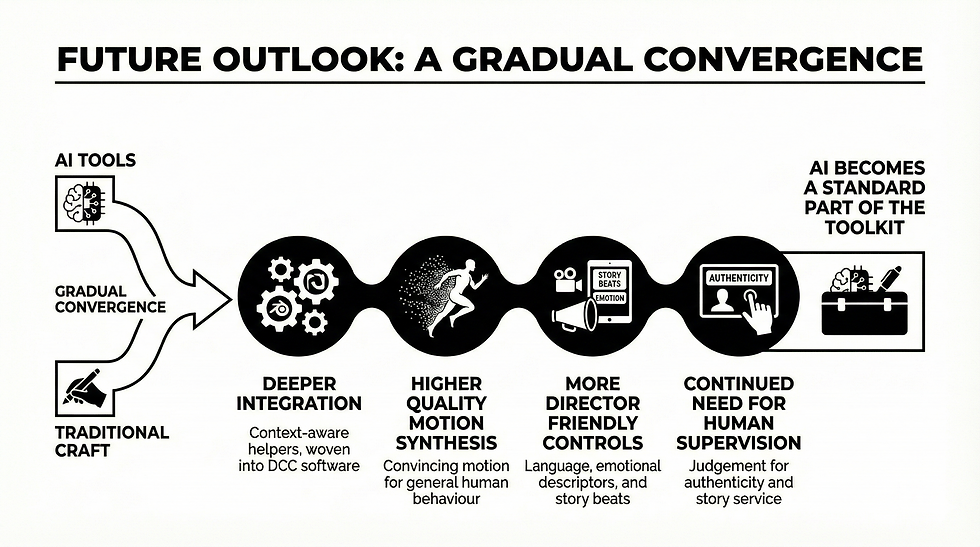
The future of AI vs traditional animation is not a win lose story. It is a gradual convergence.
We can expect to see:
Deeper integration: AI assisted tools will become more tightly woven into DCC software, game engines, and production tracking systems. Artists will access them as context aware helpers rather than separate applications.
Higher quality motion synthesis: As motion libraries grow and training methods improve, generated motion will become more convincing, especially for general human behaviour at medium distance.
More director friendly controls: Interfaces will move away from technical parameters and toward language and examples that directors and animators already use, such as emotional descriptors, camera language, and story beats.
Continued need for human supervision: Even with better tools, someone still needs to judge whether a performance feels authentic, whether it respects the performer, and whether it serves the story.
In other words, AI in animation will become one more standard part of the toolkit. Studios that understand both data driven systems and classical craft will be best placed to choose the right combination for each project.
FAQs
Does AI in animation replace animators?
No. It changes the shape of their work. Routine tasks such as cleanup, basic inbetweens, and some background motion can be automated, but the creative decisions about acting, timing, and style still come from experienced artists and directors.
Is AI better for low budget productions?
AI assisted tools can help stretch smaller budgets, especially for previs, background motion, and simple projects. However, if the story relies on nuanced character work, it is still worth investing in traditional animation for the key shots.
How does motion capture fit into AI vs traditional animation?
Motion capture is a bridge between the two. It records a real performance, which is often processed with AI driven cleanup tools, then refined by traditional animators. In practice, many high end shots blend all three elements.
Can AI help with realistic digital humans?
Yes, particularly for areas like facial capture solving, lip sync, and subtle motion variation. That said, the most convincing digital humans still rely on expert rigging, performance capture, and careful keyframe polish on top of any automated result.
How should a studio start using AI in animation safely?
Begin with non critical areas such as background motion or internal previs. Keep a human in the loop to review all outputs, track where tools are used, and be ready to revert to traditional methods if quality drops. Over time, as trust in specific tools grows, they can be applied to more important work.
Conclusion
The debate around AI vs traditional animation often sounds combative. Inside real productions, it is much more measured. Neural tools are powerful where scale, speed, and interactivity matter. Traditional animation remains central wherever emotion, storytelling, and stylistic control are critical.
The strongest studios will not declare loyalty to one side. They will build pipelines that respect the craft of animation, use AI where it genuinely adds value, and keep human judgement at the heart of every character that reaches the screen.
Contact us For further information and queries, please contact Press Department, Mimic Productions: info@mimicproductions.com
Need animation for a real production?
Mimic Productions combines experienced artists with modern tools to deliver complete character projects for advertising, film, games and immersive media.

Comments