.png)
Artificial Intelligence for Animation
Updated: Aug 27

Can artificial intelligence make animation faster without losing the craft behind believable performance?
Artificial intelligence for animation is increasingly used across film, games, advertising, XR, and digital human production. It can assist with concept development, motion capture, rigging, facial animation, lip synchronisation, cleanup, and rendering.
Its greatest value is not replacing animators, but reducing repetitive technical work while preserving creative control. In professional pipelines, AI works best as a production tool that supports artists, directors, and technical teams rather than attempting to generate finished animation without supervision.
Table of Contents
What Is Artificial Intelligence for Animation?

Artificial intelligence for animation refers to the use of machine learning, computer vision, generative models, motion prediction, and automated analysis within the creation or manipulation of animated content.
The term covers a wide range of systems.
Some tools generate images or video directly from text. Others analyse filmed performances and convert them into editable skeletal motion. Certain systems predict missing frames, track facial landmarks, generate lip movement, classify poses, retarget motion, or automate parts of character rigging.
At a professional level, the objective is rarely to press a button and receive a finished film. The more useful objective is to turn difficult, repetitive, or computationally expensive tasks into controllable starting points.
For example, a video based motion system may identify a performer, estimate body movement, solve camera position, and transfer the result to a digital skeleton. An animator can then adjust contact points, correct weight distribution, refine silhouettes, modify timing, and introduce character specific acting.
Autodesk describes contemporary AI animation systems as tools that can convert filmed scenes into editable three dimensional animation scenes containing characters, environments, and camera information. Its Flow Studio platform similarly positions automated scene reconstruction as a route into standard digital content creation workflows rather than a closed final output.
This editability is one of the clearest differences between professional animation assistance and consumer video generation.
How AI Fits Into the Animation Pipeline

Animation is a chain of dependent decisions. A change to character proportions can affect the rig. A rig change can affect motion transfer. Motion adjustments can alter cloth simulation, camera composition, lighting, and render time.
For this reason, AI cannot be evaluated only by the quality of an isolated output. It must be evaluated by how well that output survives the rest of the pipeline.
Concept Development and Previsualisation
During development, generative systems can help teams test compositions, colour directions, environments, shot ideas, and visual references.
These outputs can accelerate discussion, but they should not be confused with final art direction. Generated frames often contain unstable anatomy, inconsistent costume details, ambiguous spatial relationships, and visual decisions that cannot be reproduced across a sequence.
The strongest use is exploratory. A director can examine several possible moods before production artists define the actual design language.
AI based storyboarding and video tools are increasingly being integrated into broader editorial environments. Adobe currently presents generative features as a way to visualise shots, explore effects, create missing elements, and reduce repetitive editing work while retaining an established post production workflow.
Character Modelling and Asset Preparation
Machine learning can support mesh generation, topology suggestions, segmentation, texture creation, material variation, and geometry reconstruction.
However, animation ready characters still require deliberate technical preparation. Edge flow must support deformation. Facial topology must accommodate expressions. Materials must respond correctly under changing light. Hair and clothing need suitable simulation strategies.
Studios creating hero characters may begin with sculpting, photogrammetry, body capture, or detailed scan data before producing clean production geometry. Mimic Productions’ photorealistic character modelling process reflects this need for anatomically coherent, performance ready digital assets rather than isolated generated images.
AI can accelerate selected asset tasks, but it does not remove the relationship between modelling quality and animation quality.
Rigging and Deformation
A character rig translates animator input into deformation. It defines how joints move, how skin compresses, how muscles appear to activate, and how facial controls combine.
Automated rigging can identify likely joint positions, create skeletons, assign initial skin weights, or generate control structures. These operations can save time, especially for background figures, early tests, and large character populations.
Hero characters require more scrutiny. A generic rig may not preserve a specific performer’s shoulder rhythm, facial asymmetry, jaw mechanics, or range of expression.
Professional body and facial rigging therefore combines technical systems with anatomical observation and shot specific requirements. AI may propose a foundation, while rigging artists determine whether that foundation can carry the intended performance.
Motion Capture and Performance Reconstruction
Computer vision can estimate motion from ordinary video, reducing the need for markers in certain contexts. This is useful for previs, rapid prototyping, remote capture, secondary characters, and projects where conventional capture volumes are impractical.
The quality of reconstructed motion depends on several factors:
Camera position
Lens behaviour
Image resolution
Frame rate
Occlusion
Loose clothing
Fast rotational movement
Interaction with props or other performers
Visibility of hands, feet, and facial features
AI based reconstruction may produce a plausible motion curve while still missing physical details such as foot pressure, finger contact, balance changes, and subtle shifts of intention.
For demanding cinematic work, a controlled motion capture production remains valuable because capture design, calibration, performer direction, and data supervision occur together.
The decision is not simply AI capture or traditional capture. Productions can combine optical systems, inertial suits, markerless analysis, facial cameras, audio reference, and animator correction according to the needs of each shot.
Animation Blocking and Motion Synthesis
AI can generate or recommend motion based on text, audio, pose targets, previous frames, or a library of recorded actions.
This can help animators establish early blocking, populate crowds, create locomotion variations, or test different performance directions.
Generated motion still needs context. A character entering a room does not merely walk from one coordinate to another. The action may express caution, fatigue, authority, grief, urgency, or deception. Those qualities emerge from posture, rhythm, gaze, hesitation, spacing, and interaction with the set.
A model may predict statistically likely movement. An animator decides what the character means.
Facial Animation and Lip Synchronisation
Facial systems can analyse speech, audio intensity, phonemes, landmarks, or captured expressions to generate initial animation.
This is useful for localisation, conversational avatars, game dialogue, background characters, and large volumes of spoken content.
Yet convincing facial performance is not a mouth movement problem alone. Speech affects cheeks, jaw tension, breathing, eyelids, brows, gaze, and head movement. Emotional intention can also contradict the literal dialogue.
An AI lip sync pass may provide timing. A facial animator must still shape the performance.
Cleanup and Quality Control
Animation cleanup is one of the most practical areas for intelligent assistance.
Automated systems can detect:
Foot sliding
Mesh intersections
Sudden joint acceleration
Broken constraints
Unstable facial landmarks
Missing frames
Motion discontinuities
Camera tracking errors
Inconsistent poses
Detection is not the same as correction. A system can flag an anomaly, but an artist must determine whether it is an error, a deliberate exaggeration, or a necessary compromise for the camera.
Rendering and Compositing
AI assisted denoising can reduce the sample count required to produce a clean image. Machine learning can also support segmentation, rotoscoping, depth estimation, object removal, plate extension, frame interpolation, and colour matching.
These tools can make rendering and compositing more efficient, particularly during review.
Final image quality still depends on physically coherent lighting, materials, lens behaviour, colour management, and integration between the character and the environment.
For offline cinematic delivery, three dimensional rendering services may involve detailed shading, simulation, lighting, compositing, and final image supervision. In interactive projects, the same assets must instead be optimised for frame rate, memory limits, platform constraints, and changing camera positions.
Core AI Technologies Used in Animation

Several technical disciplines sit beneath the broad category of AI animation.
Computer Vision
Computer vision enables software to interpret image sequences. It can identify people, estimate pose, track features, separate foreground objects, reconstruct depth, and infer camera movement.
In animation, this supports markerless motion capture, facial tracking, rotoscoping, scene reconstruction, and reference analysis.
Machine Learning Based Motion Prediction
Motion models learn patterns from recorded or animated movement. They can predict transitions, complete partial motion, generate locomotion, or adapt actions to new trajectories.
The results depend heavily on training data. A model trained on generic walking may not reproduce the movement vocabulary of a specific actor, athlete, dancer, creature, or stylised character.
Generative Image and Video Models
Generative models can create visual sequences from text, images, depth maps, masks, or existing footage.
They are effective for ideation and certain short form outputs. Their main production challenges include temporal consistency, identity preservation, precise camera control, repeatable art direction, and the ability to revise individual components.
Academic surveys of generative animation identify persistent issues around visual consistency, stylistic coherence, controllability, and ethical use, even as the technology advances across storyboarding, inbetweening, colourisation, facial animation, gesture generation, and motion synthesis.
Natural Language Interfaces
Language models can translate written direction into technical operations, asset searches, scene variations, motion requests, or software commands.
This makes complex tools more accessible, but language remains imprecise. A request such as “make the movement more emotional” does not specify timing, posture, gaze, rhythm, or dramatic objective.
Natural language can initiate an operation. Professional direction still requires visual judgement.
Neural Rendering
Neural rendering uses learned representations to reconstruct or synthesise aspects of an image. It can support view generation, relighting, facial appearance, environment capture, image enhancement, and certain forms of digital human rendering.
Its usefulness depends on whether the production needs flexible three dimensional assets or only a limited set of controlled views.
Intelligent Retargeting
Retargeting transfers movement from one skeleton or character to another. AI can improve correspondence between different proportions, joint structures, and movement styles.
The result must still account for contact, centre of gravity, limb length, costume restrictions, and character personality.
AI Assisted Animation Versus Traditional Animation
Production Factor | AI Assisted Animation | Traditional Animation |
Initial speed | Rapid for concepts, blocking, tracking, and variations | Slower because artists build each stage deliberately |
Creative control | Depends on the system and availability of editable data | High control over poses, timing, arcs, spacing, and design |
Consistency | Can drift between frames, shots, or generated versions | Easier to maintain through defined assets and supervision |
Character performance | Useful for motion suggestions and initial solves | Strong for intentional acting and precise emotional choices |
Revision process | Efficient when outputs remain editable | Predictable but may require more manual labour |
Asset reuse | Limited in flattened generated video | Strong when characters, rigs, sets, and animation remain modular |
Production integration | Varies widely between tools | Established across modelling, rigging, animation, lighting, and rendering |
Best use | Assistance, iteration, automation, previs, and volume tasks | Final performance, stylised control, hero animation, and complex direction |
Main risk | Loss of control, provenance uncertainty, and inconsistency | Higher labour requirements and longer production schedules |
Modern studios already combine procedural systems, simulation, motion capture, machine learning, keyframe animation, and manual cleanup. Artificial intelligence for animation extends this hybrid approach.
The correct balance depends on the shot.
A background crowd may benefit from generated motion variation. A close facial performance may require detailed capture and animator refinement. A previs sequence may accept rough video based reconstruction. A final cinematic shot may require precise cloth simulation, muscle deformation, and offline rendering.
Applications Across Film, Games, Advertising, XR, and Digital Humans

Film and Episodic Production
In film and episodic work, AI can support previs, camera solving, rotoscoping, digital double preparation, facial analysis, motion cleanup, de ageing, crowd animation, and compositing.
The most useful applications connect to existing visual effects structures. Directors and supervisors need to review elements separately, request changes, and preserve continuity across a sequence.
A generated clip that cannot be decomposed into characters, environments, cameras, lights, and effects may be difficult to revise after editorial changes.
Game Development
Games require animation that responds to player input, physics, terrain, camera position, and gameplay state.
AI can assist with locomotion matching, transition selection, pose prediction, non player character behaviour, facial dialogue, and motion adaptation.
Unlike linear film, game animation must remain convincing under unpredictable conditions. The system may need to blend running, turning, aiming, climbing, reacting, and interacting without visible breaks.
Real time engines increasingly combine high fidelity digital characters with responsive animation systems. Epic describes MetaHuman as a framework for creating and animating realistic, emotionally expressive characters for interactive projects as well as film and television production.
Advertising and Branded Content
Advertising teams often need multiple edits, languages, aspect ratios, audience variations, and delivery formats.
AI can help create layout variations, synchronise dialogue, adapt timing, generate supporting visual material, and automate repetitive versioning.
Brand consistency remains essential. Character appearance, costume details, product geometry, colour values, and legal claims must not change unpredictably between outputs.
XR and Immersive Experiences
Extended reality requires characters and environments to respond at interactive frame rates.
AI can support speech driven gestures, gaze control, adaptive dialogue, behavioural animation, and motion prediction. However, latency and instability are immediately noticeable when a participant is standing close to a virtual character.
Studios developing real time character integration must coordinate rig complexity, engine performance, animation state logic, facial systems, rendering budgets, and interaction design.
The objective is not simply visual realism. It is responsive presence.
Conversational Digital Humans
Conversational characters combine language processing, voice synthesis, facial animation, gesture generation, and real time rendering.
A successful digital human must listen, respond, move, pause, look, and emote in a coordinated manner.
Dialogue generation can occur quickly, but character behaviour must be constrained. Gesture timing, eye contact, turn taking, emotional range, safety rules, and disclosure all affect how the interaction is perceived.
Stylised Animation
AI is not limited to photoreal imagery. It can assist with graphic motion, cartoon production, cel workflows, illustration, stop motion planning, and stylised characters.
Stylised work can be particularly demanding because every line, pose, and shape follows a deliberate visual grammar. A physically accurate result may still be wrong for the design.
Artists must protect proportion, silhouette, rhythm, and appeal.
Benefits of AI in Professional Animation

Faster Iteration
AI can generate starting points rapidly, allowing teams to test more possibilities before committing substantial resources.
This is most useful during development, previs, blocking, and early review.
Reduced Repetitive Labour
Tracking, segmentation, frame interpolation, basic retargeting, lip sync preparation, and data classification can consume significant production time.
Automation allows artists to concentrate on performance and visual decisions.
Broader Access to Complex Techniques
Small teams can use assisted systems to explore camera tracking, motion extraction, facial animation, and scene reconstruction without building every technical component from the beginning.
This does not eliminate specialist knowledge, but it can lower the barrier to experimentation.
Better Use of Capture Data
Machine learning can help organise, search, classify, clean, and retarget large motion libraries.
Animators can locate relevant actions more efficiently and adapt them to new characters or scenes.
Scalable Versioning
Dialogue driven animation, localisation, personalised content, and interactive applications may require hundreds or thousands of output variations.
AI can automate portions of this volume while human supervisors define the quality threshold.
Earlier Production Feedback
Faster previews allow directors to evaluate timing, framing, staging, and performance before expensive rendering or simulation begins.
Real time workflows already demonstrate the value of reviewing animation, cameras, lighting, and editing earlier in production.
The Future of Artificial Intelligence in Animation
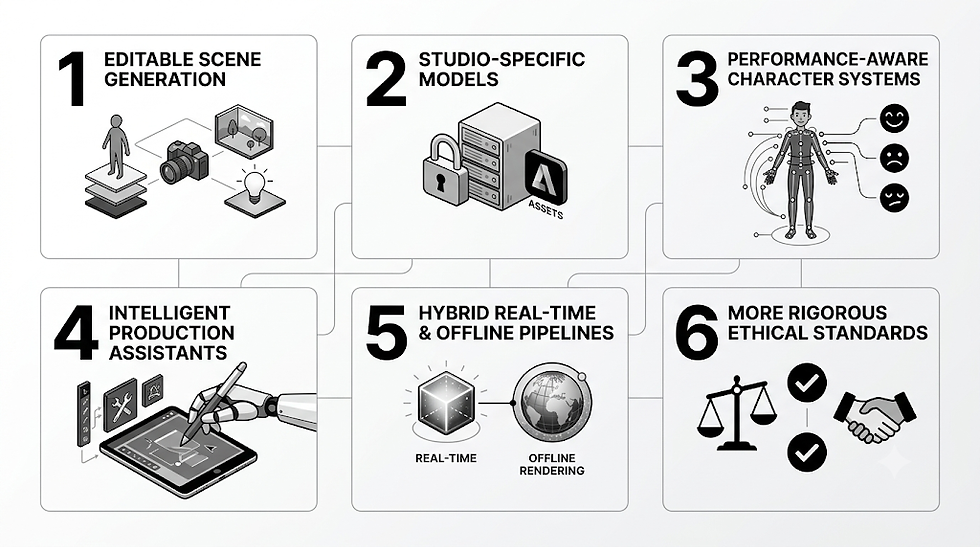
The future of artificial intelligence for animation is likely to be defined by greater control rather than unrestricted generation.
Studios do not simply need more images. They need systems that understand scenes as structured, editable productions.
Several developments are particularly significant.
Editable Scene Generation
Future systems will increasingly separate characters, cameras, environments, motion, lighting, and effects.
This will make generated material easier to direct and integrate with Maya, Blender, Houdini, Unreal Engine, and established compositing tools.
Studio Specific Models
Production companies may train or adapt models using approved internal assets, motion libraries, rigs, and visual rules.
This could improve stylistic consistency while protecting proprietary material.
Performance Aware Character Systems
Animation models will become better at interpreting speech, emotion, intention, environment, and interaction together.
The challenge will be preserving the nuance of the original actor while allowing directors and animators to refine the result.
Intelligent Production Assistants
Language interfaces may help artists find assets, build scene variations, check technical errors, convert notes into tasks, and automate repetitive software operations.
The assistant will not replace departmental expertise. It will help specialists navigate increasingly complex tools.
Hybrid Real Time and Offline Pipelines
Real time engines will continue to support layout, animation review, virtual production, and interactive delivery. Offline rendering will remain important for shots requiring dense simulation, complex light transport, detailed hair, or extreme image quality.
Assets will increasingly move between both environments.
More Rigorous Ethical Standards
Consent, attribution, provenance, disclosure, and performer control will become formal parts of the animation pipeline.
Responsible studios will treat these requirements as production infrastructure rather than optional policy.
Artificial intelligence will continue to change how animation is made. Its lasting value will depend on whether it strengthens creative control, protects contributors, and produces assets that survive professional scrutiny.
Frequently Asked Questions
What is artificial intelligence for animation?
Artificial intelligence for animation is the use of machine learning, computer vision, generative systems, and automated analysis to assist with tasks such as storyboarding, motion capture, rigging, lip synchronisation, inbetweening, cleanup, rendering, and scene creation.
Can AI create a complete animated film?
AI can generate concepts, clips, voices, motion, and supporting assets, but long form production requires consistent characters, controlled camera work, editable scenes, narrative continuity, performance direction, sound, lighting, compositing, and legal clearance.
A complete film therefore remains a supervised production rather than a single automated output.
Will AI replace animators?
AI is more likely to change the tasks animators perform than remove the need for animators.
Systems can automate tracking, initial motion solves, lip sync, cleanup detection, and repetitive variations. Animators remain responsible for acting, timing, appeal, physical credibility, style, and directorial interpretation.
How does AI improve three dimensional animation?
AI can assist with pose estimation, motion reconstruction, rig preparation, retargeting, simulation prediction, facial tracking, asset organisation, rendering, and quality control.
The strongest results occur when these tools produce editable data that artists can refine.
Is AI generated animation suitable for professional production?
It can be, depending on the tool, output structure, project requirements, and level of supervision.
A generated result must be assessed for consistency, editability, physical accuracy, provenance, rights, and compatibility with the wider pipeline.
What is the difference between AI animation and motion capture?
Motion capture records the movement of a performer. AI animation can include motion generation, prediction, video based pose reconstruction, lip sync, inbetweening, and other forms of automation.
Machine learning may be used inside a motion capture pipeline, but the two terms are not interchangeable.
Can AI animate a digital human in real time?
Yes. AI can generate speech related facial movement, gestures, gaze, and behavioural responses for real time digital humans.
The system must still manage latency, rig performance, rendering limits, emotional consistency, and interaction safety.
What are the ethical concerns around AI animation?
Major concerns include unlicensed training data, unauthorised performer likenesses, synthetic voices, unclear ownership, style imitation, hidden manipulation, and the absence of informed consent.
Responsible production requires documented permissions, traceable assets, clear contracts, and human review.
Which parts of animation benefit most from AI?
The most immediate benefits often appear in previs, tracking, segmentation, motion extraction, lip sync preparation, retargeting, cleanup detection, rendering assistance, and high volume content variation.
Hero performance and final artistic direction still require detailed human supervision.
Conclusion
Artificial intelligence for animation is becoming an important part of modern character and content production, but its role must be understood precisely.
It is not a substitute for anatomy, acting, design, cinematography, or animation judgement. It is a collection of technologies that can accelerate individual stages of a larger pipeline.
The strongest workflows combine machine efficiency with artist control. They use AI to process data, create starting points, detect problems, and expand iteration while preserving the character, performance, and shot as editable production assets.
For film, games, advertising, XR, and digital humans, this hybrid model offers the most credible path forward.
The future of animation will not be defined by whether a machine can produce movement. It will be defined by whether artists can direct that movement, refine it, own it, and use it to communicate something intentional.
For inquiries, please contact: Press Department, Mimic Productions info@mimicproductions.com


Comments