.png)
How Brands Build Digital Athletes
Updated: Aug 27

What happens when an athlete no longer needs to be physically present to train, perform, promote, or appear on screen?
Digital athletes are becoming one of the most useful forms of character production in sport, fitness, and performance marketing. For brands, clubs, broadcasters, and training platforms, they offer something traditional production cannot: a controllable, reusable, high fidelity human asset that can move across campaigns, products, games, XR experiences, retail activations, and performance analysis workflows.
At Mimic Productions, that logic aligns naturally with a studio pipeline built around scanning, motion capture, rigging, animation, and real time deployment. Mimic’s own sports and fitness offering is built around exactly that production chain, and the studio has already applied similar methods in athlete focused campaigns including Emma Raducanu for Vodafone and advertising work involving Cristiano Ronaldo.
This article uses Digital Athletes as the main concept anchor, while also covering related search language such as virtual athletes, athlete digital doubles, sports digital humans, fitness avatars, 3D athlete models, sports character creation, performance capture for athletes, and real time sports characters. The tone, structure, and internal linking approach follow the Mimic Productions editorial framework.
Table of Contents
What Digital Athletes Actually Are
A digital athlete is not simply a stylized avatar wearing sportswear. In professional production terms, it is a structured 3D character asset based on a real performer, a designed persona, or a hybrid of both. The asset is built with usable anatomy, believable surface detail, stable deformation, animation readiness, and deployment logic for the intended medium. That medium might be a broadcast promo, a mobile fitness app, a game engine, a volumetric installation, or a live XR activation. This is why the category sits closer to digital human production than to casual avatar design.
For sports and fitness brands, realism matters because audiences know what elite movement looks like. They understand balance, timing, acceleration, fatigue, and body control instinctively. A runner with poor hip mechanics or a footballer with incorrect weight transfer will feel false immediately. Building convincing sports characters therefore depends on far more than visual likeness. It requires motion fidelity, clean rig behavior, garment response, and an execution pipeline that preserves athletic identity rather than flattening it into generic animation.
This is where a full character pipeline becomes decisive. Mimic describes its own work as an end to end process from scanning to rigging and from motion capture to animation, which is exactly the level of integration sports brands need when they want digital athletes to function across more than one campaign or platform.
Why Sports and Fitness Brands Are Building Them

Sports brands are no longer commissioning digital characters only for spectacle. They are doing it because a well built athlete asset can solve multiple production problems at once.
First, a digital athlete extends presence. A brand ambassador can appear in multiple formats without requiring repeated physical shoots. That matters in global campaigns where timing, travel, usage rights, and localization all affect cost and execution. Vodafone’s Wimbledon activation featuring Emma Raducanu showed how a lifelike digital version of an athlete could drive a large scale public campaign in a way that felt performative rather than merely illustrative. Mimic Productions was credited as the studio behind that digital avatar.
Second, a digital athlete creates continuity across channels. The same character can live in a hero film, a retail display, an interactive kiosk, a training experience, or a game engine environment. That continuity is increasingly valuable because sports audiences now move fluidly between physical venues, social content, streaming platforms, and immersive environments. Broader industry coverage of AR in sports and avatar based brand interaction points in the same direction: sports engagement is becoming layered, spatial, and persistent rather than tied to one screen or one event.
Third, digital athletes allow brands to dramatize performance itself. In sport, the body is the story. Muscle tension, footwear response, impact, cadence, and technique can all be isolated, stylized, or exaggerated through CG without losing the truth of the movement. That makes digital athletes especially powerful for footwear launches, apparel visualization, biomechanics storytelling, and premium brand films.
Fourth, they create a bridge between athletic identity and digital product ecosystems. As sports, gaming, and immersive media continue to overlap, a brand can no longer think of a player likeness as a single campaign deliverable. It has to think in terms of reusable character infrastructure.
How the Production Pipeline Works
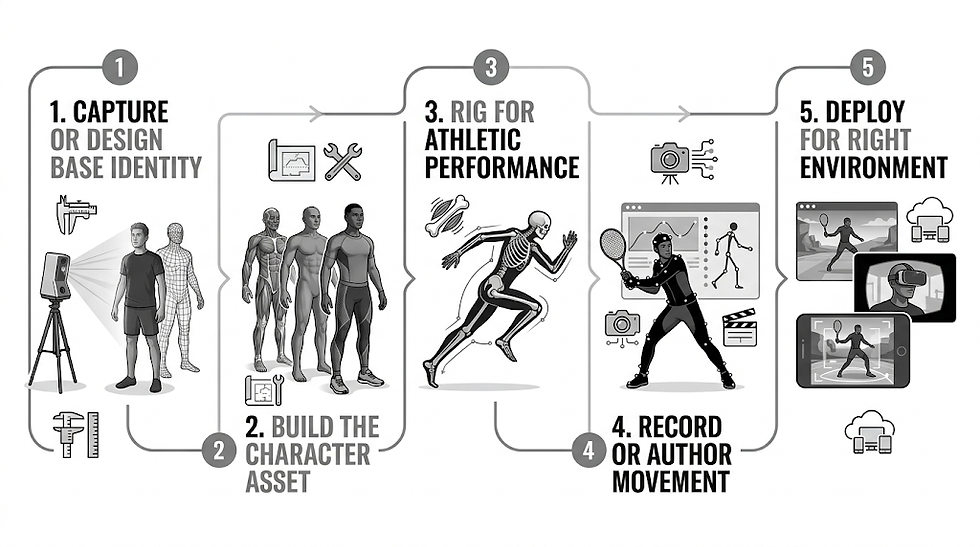
The strongest sports characters are built through a pipeline, not through isolated tasks.
1. Capture or Design the Base Identity
Some digital athletes begin with a real person. Others begin with a concept. In both cases, the work starts with anatomy, proportion, and intended use. When a real athlete is involved, high resolution 3D body scanning provides accurate geometry and surface information that can anchor likeness, posture, and garment fit. Mimic’s scanning service is explicitly designed for digital doubles, character modeling, and VFX quality asset creation.
When the character is not a one to one replica, scanning can still inform the build by providing reference truth for body volume, skin breakup, and physical asymmetry. That matters because sports bodies are rarely neutral. They carry discipline specific development: a sprinter does not read like a tennis player, and a boxer does not occupy space like a swimmer.
2. Build the Character Asset
Once base data is established, the next stage is character construction. Topology, facial structure, muscle flow, clothing layers, hair, and material response all have to serve the final use case. A sports brand may need a photoreal hero asset for close camera work, a lighter real time variant for XR, or both. This is where 3D character services become essential, because the asset has to hold up not only in still frames but in motion, under scrutiny, and across delivery formats.
For fitness and sports use, clothing is not decorative. It is performance language. Compression fabric, shoe structure, seam placement, and material tension all contribute to credibility. When the asset is meant to represent a premium product ecosystem, apparel construction and deformation must be treated with the same seriousness as the body underneath.
3. Rig for Athletic Performance
Athletic motion exposes weak rigging immediately. Sprint starts, rotational force, landing compression, shoulder articulation, and rapid direction changes place very different demands on a character than conversational acting does. A production ready sports character therefore needs robust body and facial rigging that can preserve form under stress, support clean retargeting, and remain stable through both subtle and explosive movement.
Good rigging is rarely visible when it works. What the viewer perceives instead is confidence: the ankle plants correctly, the torso carries momentum, the face survives exertion, and the silhouette remains coherent. In sports storytelling, that invisible engineering is what makes a digital athlete feel trained rather than fabricated.
4. Record or Author Movement
Sport is movement first. For that reason, motion capture remains one of the most valuable tools in this category. Mimic’s recent writing on motion capture for sports makes the point clearly: the value is not in recording movement alone, but in accurate capture, clean solving, intelligible rig behavior, efficient playback, and usable presentation. That observation is especially important for sports and fitness brands because the end product is often reviewed not just by creatives, but by athletes, coaches, product designers, and technical stakeholders.
Not every sequence needs pure capture. Many productions combine captured data with hand animation, cleanup, retargeting, and performance enhancement. That hybrid approach is often the right one. It protects realism while allowing timing, framing, and silhouette to be tuned for camera, narrative, or interface design.
5. Deploy for the Right Environment
A sports brand rarely needs only a cinematic render. It usually needs flexibility. That is why real time integration matters. A digital athlete that works only in an offline render may still be useful, but a character that can be adapted for game engines, XR installations, interactive training systems, or live branded experiences has a much longer strategic life. Mimic’s sports and fitness page explicitly frames this around virtual and augmented reality, optimization logic, and metaverse ready use cases.
At that point, the character stops being a one off asset and becomes a reusable production system.
Comparison Table
Category | Digital Athletes | Traditional Sports Production |
Athlete presence | Can be reused without repeated physical attendance | Requires new shoot time for each activation |
Movement control | Capture, retargeting, cleanup, and stylization are possible | Limited to what was filmed on set |
Cross platform use | One core asset can serve film, XR, app, game, and display workflows | Separate production often needed for each format |
Product visualization | Apparel, footwear, and body mechanics can be isolated and examined precisely | Harder to dissect motion and product interaction clearly |
Localization | Environments, language layers, and outputs can be adapted efficiently | Reshoots or additional edits may be required |
Long term asset value | Functions as reusable character infrastructure | Often tied to a single campaign cycle |
Ethical control | Can be built with explicit consent, defined approvals, and provenance | Also rights managed, but with less asset persistence once production ends |
The comparison is not about replacing live action. It is about recognizing that sports and fitness brands now operate across environments where a filmed athlete and a digital athlete serve different purposes. The most advanced campaigns use both.
Applications

Brand Campaigns and Product Launches
Digital athletes are highly effective in premium campaign work because they allow a brand to put movement under a microscope. A football boot strike, a tennis serve, or a sprint acceleration can be staged with physical plausibility while still giving directors more control over camera language, timing, and environmental design than a conventional shoot allows.
This is also where athlete likeness becomes commercially powerful. Mimic notes work involving Cristiano Ronaldo in advertising, and the Emma Raducanu activation showed how a digital athlete can become the center of a public facing campaign rather than a background effect.
Training and Biomechanics Communication
Not every sports character is made for marketing. Some are built to reveal movement. Mimic’s recent sports motion capture article places biomechanics and athlete training firmly within the conversation, which is significant because it shows how sports character production is converging with applied performance analysis.
For brands in the fitness sector, this can translate into clearer coaching content, movement education, rehabilitation visualization, and premium digital training experiences. A digital athlete can demonstrate not only what to do, but how force travels through the body and where technique breaks down.
Gaming and Immersive Sport
Sports audiences are already comfortable with virtual competition, stylized arenas, and digital identity. That makes gaming and immersive sport a natural home for athlete grade character work. When a sports brand wants a photoreal player, a stylized training companion, or a branded performance character inside an interactive environment, the same production disciplines still apply: good scanning, strong rigging, clean motion data, and performance aware optimization. Mimic’s sports page makes clear that XR delivery requires deliberate attention to polycount limits and level of detail strategy without sacrificing visual quality.
Retail, Events, and Interactive Presence
A digital athlete can also function as a branded presence rather than a narrative character. In retail or event contexts, that might mean a life sized virtual ambassador, an interactive holographic appearance, or a mixed reality product demo. The value here is not novelty alone. It is the ability to maintain a recognizable performance identity across physical and digital touchpoints.
Fitness Platforms and Digital Coaching
Fitness brands are especially well positioned to use digital athletes because the category already depends on repeatable guided movement. A high quality virtual trainer or brand specific performance persona can deliver consistency, multilingual adaptation, visual clarity, and platform scalability. The challenge is that fitness audiences are extremely sensitive to bodily credibility. Poor joint behavior, soft weight transfer, or generic movement language will weaken trust immediately.
Benefits

Reusability Without Creative Stagnation
A properly built digital athlete can be re lit, re animated, re dressed, and re staged without starting over. That gives sports and fitness brands a reusable hero asset that still supports creative variation.
Better Control Over Athletic Storytelling
Digital production allows directors and product teams to reveal motion in ways that live action cannot always achieve. This is especially useful when performance detail is part of the brand message.
Stronger Cross Channel Consistency
The same character logic can flow from hero campaign to real time app to event activation, reducing fragmentation in how the athlete or performance concept is presented.
More Efficient Global Adaptation
A reusable 3D athlete can support market specific outputs, localized creative, and new environments without requiring a full physical reshoot for every variation.
Higher Technical Value Over Time
Unlike a one time filmed asset, a sports digital human can evolve. It can be upgraded for a new engine, repurposed for a new format, or extended with new apparel, motion libraries, or interface behavior.
More Responsible Rights Management
The strongest digital athlete workflows are consent driven, version controlled, and explicit about approvals. Mimic’s own publishing around digital humans emphasizes consent first capture and verifiable provenance, which is exactly the standard athlete centered work now requires.
Future Outlook
The next stage of digital athletes will be defined by interoperability, intelligence, and trust.
Interoperability means the same athlete asset will need to move smoothly between cinematic rendering, real time engines, mobile experiences, live installations, and AI assisted interfaces. The production challenge is no longer just making the character look convincing once. It is making the character remain coherent across contexts.
Intelligence means these assets will become more responsive. Industry coverage already points toward athlete related AI avatars being used for fan engagement and new forms of licensing. That trend will likely expand into coaching interfaces, branded digital assistants, interactive museum experiences, and sports education systems.
Trust means provenance, consent, and approval logic will become central, especially when working with recognizable athletes. In a mature pipeline, realism is not enough. The source of the likeness, the permitted use, and the boundaries of performance all need to be documented.
For studios and brands that understand character production deeply, this is an opportunity rather than a constraint. The winners in this space will not be the loudest. They will be the teams that treat digital athletes with the same seriousness as film grade character work.
FAQs
What are digital athletes?
Digital athletes are 3D character representations of athletes or athlete inspired personas used across sports marketing, fitness platforms, training visualization, games, XR experiences, and live activations. They can be photoreal digital doubles, stylized performance characters, or hybrid branded avatars.
How are digital athletes created?
They are typically built through a pipeline that includes concept development or scan capture, character modeling, rigging, motion capture or animation, look development, and deployment for offline or real time use. Mimic’s public service structure reflects this full chain from scanning to animation.
Why are sports brands using 3D characters?
Because 3D athlete assets can be reused across campaigns, products, retail, immersive media, and digital training tools while giving brands more control over movement, product storytelling, and global adaptation.
Are digital athletes only for gaming?
No. They are useful in advertising, product launches, fan engagement, sports education, biomechanics communication, virtual events, retail displays, and fitness coaching platforms.
What is the difference between a digital athlete and a digital double?
A digital double is usually a highly accurate replica of a specific person for realism driven use. A digital athlete can be that, but it can also be a designed sports character or branded performance persona built for broader commercial or interactive use. Mimic’s own publishing makes similar distinctions across digital doubles, digital humans, and related character categories.
Why does rigging matter so much in sports character creation?
Because athletic movement places heavy demands on joints, deformation, timing, and weight transfer. Weak rigging breaks the illusion immediately, especially in sprinting, jumping, striking, rotation, or close camera work.
Can digital athletes work in real time experiences?
Yes, but only when the asset is prepared for the target environment. That usually requires optimization, level of detail planning, and careful technical integration for engines and devices. Mimic’s sports and fitness service specifically highlights these XR oriented requirements.
Are digital athletes ethical to use?
They can be, provided the work is consent driven, rights cleared, and transparent about how likeness and performance data are captured, approved, and deployed. In athlete centered production, ethics is part of the pipeline, not a note added afterward.
Conclusion
Digital athletes sit at the intersection of sport, cinema, performance technology, and branded world building. They are not useful because they are futuristic. They are useful because they solve real production needs with a level of control, continuity, and craft that sports and fitness brands increasingly require.
For studios with genuine character expertise, the opportunity is clear. Build the athlete as a serious digital asset, respect the mechanics of the body, preserve the truth of performance, and design for more than one endpoint. When that happens, a digital athlete becomes more than a visual effect. It becomes a durable piece of brand infrastructure.
For inquiries, please contact: Press Department, Mimic Productions info@mimicproductions.com


Comments