.png)
AI in Influencer Marketing
Updated: Aug 27
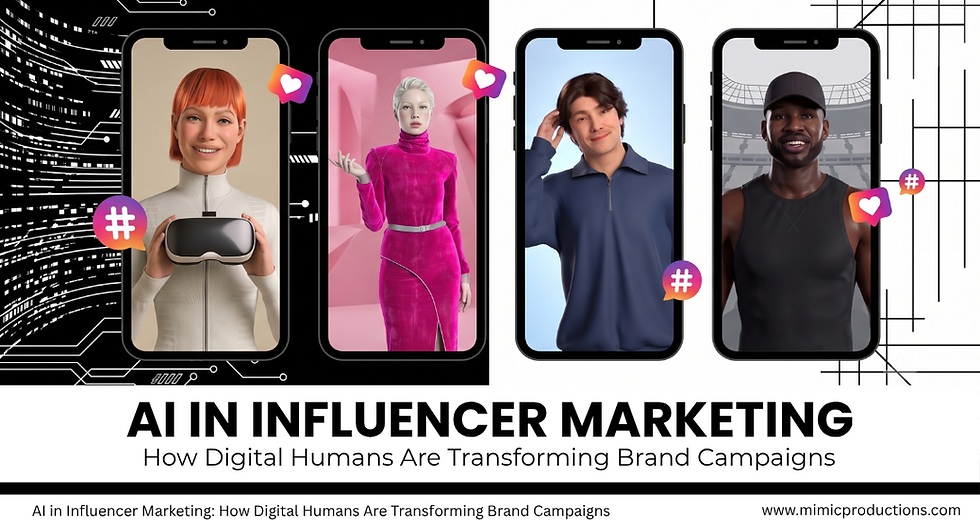
What happens when a brand no longer depends on a creator’s travel schedule, location, availability, or even physical presence to launch a campaign?
AI in influencer marketing is changing the structure of brand storytelling. What began as a model for creator partnerships is evolving into something more controlled, more scalable, and in many cases, more cinematic. Brands are no longer limited to selecting a human face and building a campaign around that individual’s time, audience, and personal image. They can now develop persistent digital personalities designed for specific markets, product categories, and formats.
This shift matters because modern campaigns are no longer built for a single photoshoot or one social post. They are expected to move across short form video, interactive commerce, live events, regional localization, digital out of home, virtual experiences, and real time engagement. Human creators still matter, but digital humans introduce a different production model, one built around ownership, continuity, and technical precision.
The most effective virtual personalities are not generated as surface level novelties. They are built through the same disciplines that define high end character production, including scanning, modeling, rigging, performance capture, look development, animation, and deployment across real time and rendered environments. That is where digital humans begin to separate themselves from generic synthetic media.
For brands, the question is no longer whether AI will influence influencer marketing. It already does. The real question is what kind of digital presence can hold attention, maintain trust, and perform consistently across campaign formats.
Table of Contents
What AI in Influencer Marketing Really Means

AI in influencer marketing is often discussed as a set of software tools for creator discovery, campaign planning, audience analysis, content drafting, or performance measurement. That is one layer of the shift, but it is not the whole story.
A more important development is the rise of AI driven virtual talent, digital personas that can appear in branded campaigns, speak across languages, maintain a consistent look, and exist across multiple channels without the operational limits of a conventional creator relationship. Current industry coverage increasingly treats AI as both a workflow layer and a creator layer, with virtual influencers becoming a more established part of the broader creator economy.
That distinction matters. A marketing team using AI for briefs, analytics, or scheduling is still operating within a traditional creator model. A team building or commissioning a digital human is changing the production model itself.
This is where brands begin to think less like social managers and more like studios. They are not simply booking talent. They are developing a controllable campaign asset, one that can be art directed, localized, animated, updated, and reused. For businesses exploring digital influencers and virtual talent, the conversation quickly moves beyond content automation and into character design, identity management, production quality, and long term brand ownership.
Why Digital Humans Fit Modern Brand Campaigns

The appeal of digital humans is not just availability. It is precision.
Brand campaigns today need continuity across many surfaces. A single launch may require hero stills, vertical social assets, product explainers, interactive brand moments, localized market versions, and live or real time activations. Traditional influencer campaigns can be powerful, but they are also vulnerable to scheduling friction, uneven visual consistency, and limited control over how a personality evolves over time.
Digital humans solve a different problem. They allow brands to design a campaign face with intentionality from the beginning. Appearance, wardrobe language, facial expression range, body performance, tone of voice, and behavioral boundaries can all be defined as part of the production strategy.
That level of control does not mean the work becomes easier. It means the work becomes more technical. A credible digital personality must hold up under close viewing. Skin response, eye behavior, deformation quality, lip sync, cloth motion, and lighting integration all affect whether a character feels premium or artificial. This is why serious campaign work often depends on AI avatar development that is connected to real character pipelines rather than template based generation alone.
For luxury, fashion, automotive, beauty, entertainment, and technology brands, this is particularly important. In these sectors, surface quality is part of the message. If the character breaks under scrutiny, the campaign breaks with it.
How Digital Humans Are Built for Campaign Use

A convincing digital brand ambassador is not created by prompt alone. It is the outcome of multiple production disciplines working together.
Character design and identity definition
The process usually begins with visual development. Teams define the role of the character, its demographic positioning, intended audience, visual language, and campaign function. Is the character a fashion personality, a futuristic host, a beauty guide, a product educator, or a branded world builder? Those decisions shape everything that follows.
Scanning, modeling, and look development
When realism is the goal, facial and body data often begin with high resolution capture or reference based sculpting. Surface fidelity depends on topology quality, texture creation, material response, and hair and wardrobe treatment. This is where 3D character services become central. The work is less about producing a static likeness and more about building a production ready performer.
Rigging and deformation
A campaign character must emote, speak, and move naturally. That requires robust facial systems, body controls, corrective shapes, and careful deformation design. In beauty or close up advertising, weak rigging is immediately visible. A digital human is only as believable as its ability to perform.
Motion and performance capture
The strongest digital influencer campaigns usually retain a layer of real performance. Facial capture, body mocap, or full performance capture gives the character timing, rhythm, and intention that are difficult to fake at scale. Even stylized personalities benefit from grounded human motion. This is especially true for expressive social content, product demonstrations, and live activations.
Rendering and deployment
Some campaigns demand cinematic offline rendering for hero films and high end stills. Others need real time deployment for interactive environments, live presentations, or rapid content iteration. The most flexible productions are designed with both in mind, allowing assets to move from polished launch media into responsive experiences through real time integration workflows.
This is what separates a usable digital human from a one off visual experiment. It is not just a model. It is a system.
Human Influencers vs Digital Humans
Both models can be effective. They simply operate under different constraints.
Factor | Human Influencers | Digital Humans |
Availability | Dependent on calendar, travel, and contracts | Available across markets and time zones |
Visual consistency | Varies across shoots and environments | Controlled across every campaign asset |
Brand control | Shared with creator identity and public behavior | Defined by the brand and production team |
Production method | Social first, personality led | Character pipeline, performance led |
Localization | Requires multiple shoots or edits | Can be adapted for language and regional rollout |
Risk profile | Subject to public controversy and schedule disruption | Requires governance, consent, and technical oversight |
Reusability | Campaign by campaign | Long term asset with repeat deployment value |
The right choice depends on campaign goals. A brand seeking human spontaneity, creator credibility, and community intimacy may still prefer traditional partnerships. A brand seeking consistency, visual control, multilingual deployment, and long term ownership may lean toward digital talent.
Increasingly, agencies are not choosing one or the other. They are building hybrid strategies where human creators and virtual personalities coexist in the same campaign ecosystem. That blend is especially relevant for advertising agency partnerships that need both campaign flexibility and production depth.
Where Brands Are Using Digital Personalities

Digital humans are not limited to a single type of activation. Their value comes from adaptability.
Product launches
A digital brand ambassador can appear in teaser content, launch films, product explainers, and commerce assets without requiring multiple shoot days. This is particularly useful for coordinated global releases.
Fashion and beauty storytelling
These sectors benefit from precision in styling, body language, close up facial detail, and repeatable brand aesthetics. Digital talent can carry a distinct editorial identity across seasonal campaigns.
Interactive retail and commerce
Virtual personalities can move beyond passive promotion into guided shopping, product education, and conversational experiences. In this context, the line between influencer, host, and customer interface starts to blur.
Events and immersive activations
A digital persona can extend into holographic appearances, immersive installations, or live interactive moments. The same campaign character used in social media can reappear in spatial experiences, branded worlds, or virtual showcases.
Entertainment and franchise promotion
Studios and IP holders can use digital talent to bridge film marketing, fan engagement, social content, and real time appearances while maintaining continuity of character identity.
Benefits for Brands and Agencies
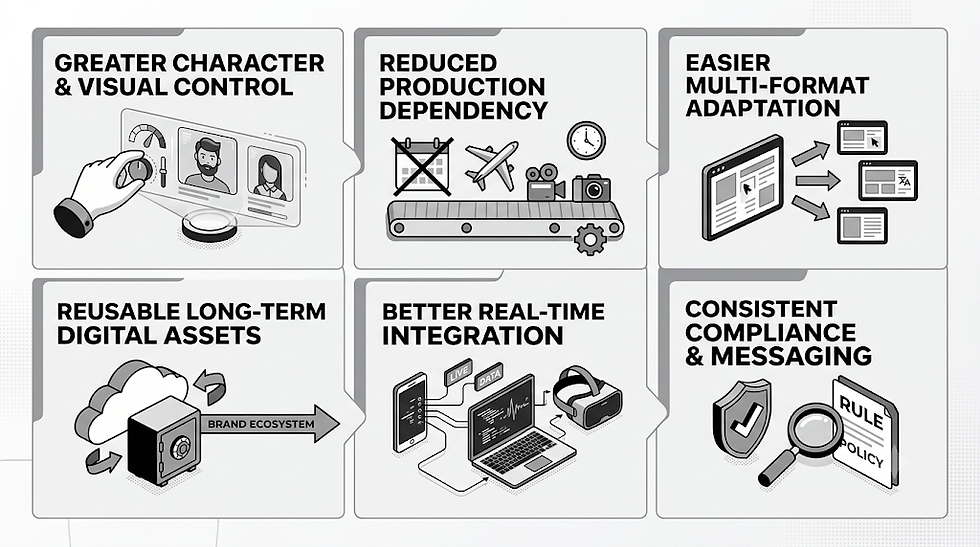
The value of AI in influencer marketing becomes clearer when viewed through production logic rather than novelty.
Greater control over character identity, visual language, and campaign continuity
Reduced dependency on external schedules, travel complexity, and repeated physical production
Easier adaptation across languages, territories, and content formats
Reusable digital assets that can support long term brand ecosystems
Better integration with real time, interactive, and immersive campaign formats
More consistent compliance, governance, and messaging frameworks when handled responsibly
That final point deserves emphasis. Digital humans should not be treated as loopholes around trust. They require clear authorship, consent aware production practices, and transparent brand use. Audiences are increasingly alert to synthetic media, and credibility depends on how honestly the work is framed. Industry discussion around virtual creators continues to center on authenticity, disclosure, and the need for responsible use as AI driven creator formats become more common.
Future Outlook

The next phase of AI in influencer marketing will not be defined by who can generate the fastest synthetic face. It will be defined by who can build the most coherent digital presence across channels, formats, and audience expectations.
We are likely to see campaign ecosystems where digital humans are no longer isolated to social posts. They will act as persistent brand entities across commerce, customer experience, XR environments, live activation, and serialized content. They may shift fluidly between rendered hero work and real time interaction, between scripted brand campaigns and responsive conversational experiences.
As this happens, production quality will become the differentiator. Audiences will quickly learn to distinguish between disposable synthetic content and characters that have been built with real craft. The brands that benefit most will be the ones that treat digital humans as performance assets, not gimmicks.
That means investing in believable surfaces, disciplined rigging, expressive animation, ethical frameworks, and deployment systems that fit real campaign needs. In other words, it means approaching influencer strategy with the rigor of character production.
FAQs
What is AI in influencer marketing?
AI in influencer marketing refers to the use of artificial intelligence across creator strategy, campaign planning, content production, measurement, and increasingly, the creation of virtual influencers or digital humans used directly in branded campaigns.
Are digital humans replacing human influencers?
Not entirely. Human creators still offer lived experience, community trust, and spontaneous personality. Digital humans are better understood as a parallel model that offers control, scalability, and repeatable visual consistency.
What makes a digital human effective in a brand campaign?
Believability, clear character identity, strong art direction, natural performance, and technical quality. Scanning, rigging, motion capture, animation, shading, and rendering all contribute to whether the character feels credible on screen.
Which industries benefit most from digital influencer campaigns?
Fashion, beauty, luxury, automotive, entertainment, technology, retail, and immersive brand experiences are among the strongest use cases because they benefit from visual control and multi format deployment.
Are virtual influencers only useful for social media?
No. They can also be used for live events, product explainers, commerce experiences, XR activations, and multilingual campaign rollouts.
What is the main risk of using digital humans in marketing?
The biggest risks are weak execution and weak governance. Poor quality characters can damage brand perception, and unclear disclosure or consent practices can undermine trust.
Conclusion
AI in influencer marketing is not simply automating an existing channel. It is reshaping who or what can represent a brand.
Digital humans offer something traditional influencer models cannot fully provide, a persistent, controllable, production ready personality that can move across media, regions, and interaction formats with unusual consistency. But that advantage only holds when the work is built properly. A credible digital brand presence depends on the same craft that underpins film grade character creation, from scanning and rigging to capture, animation, and deployment.
For brands, the opportunity is substantial. So is the responsibility.
The future of influencer marketing will not belong to the loudest synthetic content. It will belong to the most believable, well directed, ethically produced digital personalities, the ones built with enough technical depth to perform like real campaign assets rather than temporary effects.
For inquiries, please contact: Press Department, Mimic Productions info@mimicproductions.com


Comments